
Cervical Myelopathy: Spinal Stenosis Symptoms and When Surgery Is Needed

What Is Cervical Myelopathy?
Cervical myelopathy is a neurological condition caused by compression of the spinal cord in the neck. It's not just about a narrow spine-it's when that narrowing actually damages the spinal cord, leading to real, measurable loss of function. Most cases come from cervical spondylotic myelopathy (CSM), which happens as we age. The discs between vertebrae dry out and collapse, bone spurs grow, ligaments thicken, and the spinal canal-normally 17-18mm wide-shrinks to 13mm or less. When it drops below 10mm, the cord is in serious danger.
Unlike simple spinal stenosis (which is just a structural change), cervical myelopathy means the spinal cord is injured. You can have stenosis without myelopathy-about 21% of people over 40 have narrowing but no symptoms. But if you start losing hand control, stumbling while walking, or having trouble with buttons, that’s myelopathy. It’s not normal aging. It’s a medical red flag.
Early Signs You Can’t Ignore
The first symptoms are subtle, which is why so many people delay getting help. You might notice your handwriting getting messy, or dropping things like keys or glasses. Your fingers feel stiff or numb, especially in the morning. You start fumbling with zippers or phone screens. These aren’t just "getting older"-they’re signs your spinal cord is being squeezed.
Neurologists look for specific clues during exams. Over 85% of patients show exaggerated knee and ankle reflexes. That’s not something you feel yourself-it’s detected by a doctor tapping your tendons. Another 72% report hand clumsiness. Around 68% have trouble walking steadily. You might feel like you’re walking on a boat, or your feet feel heavy. Balance issues come next. Many patients say they’ve fallen more than once, even on flat ground.
As it progresses, you might feel burning or tingling down your arms. Some get neck or shoulder pain, but not everyone. The most concerning signs show up later: trouble controlling your bladder-sudden urgency, or worse, accidents. That’s a late-stage warning. Once you’re dealing with bowel or bladder dysfunction, the spinal cord has been damaged for a long time.
How Doctors Confirm the Diagnosis
There’s no single test. Diagnosis needs two things: symptoms and imaging proof. A regular X-ray might show bone spurs or disc space narrowing, but it won’t show spinal cord damage. That’s where MRI comes in. It’s the gold standard-97% accurate at spotting compression and cord injury.
A good MRI doesn’t just show a narrow canal. It looks for T2-weighted hyperintensity-a bright signal inside the spinal cord. That’s the fingerprint of ongoing injury. Without that signal, you might just have stenosis, not myelopathy. Some patients get CT myelography if they can’t have an MRI, but it’s less common now.
Doctors also use the Japanese Orthopaedic Association (JOA) score. It’s a simple 17-point test that checks hand movement, walking, sensation, and bladder control. A score below 14 means myelopathy. Below 12? That’s moderate to severe. This score isn’t just for diagnosis-it tracks progress before and after surgery.
Electromyography (EMG) and sensory tests can catch nerve problems before symptoms appear. In early cases, up to 60% show abnormal signals even if they feel fine. That’s why waiting for pain to get worse is risky.

When Surgery Is the Only Real Option
Conservative treatment-physical therapy, NSAIDs, activity changes-works for a small group. Only 28% of mild cases improve over two years. Meanwhile, 63% get worse. That’s not a gamble you want to take.
For moderate to severe myelopathy (JOA score under 12), surgery is the standard. The American Academy of Orthopaedic Surgeons gives it a strong, evidence-backed recommendation. Studies show 70-85% of patients improve after surgery. Without it, 20-60% will keep getting worse, with some ending up paralyzed.
Timing matters. Surgeons who treat patients within six months of symptoms seeing a 37% better recovery than those who wait over a year. Every month you delay, you lose about 3% of your recovery potential. That’s not a small number-it’s the difference between walking normally and needing a cane.
Types of Surgery and What to Expect
There are three main approaches: front, back, or both.
- Anterior Cervical Discectomy and Fusion (ACDF): This is the most common for one or two levels. The surgeon removes the damaged disc and bone spurs from the front of the neck, then fuses the vertebrae with a bone graft and plate. Success rate? 85-90% neurological improvement. But 5-7% of patients develop problems in adjacent levels within 10 years.
- Cervical Disc Arthroplasty (Artificial Disc): This replaces the disc without fusion. The M6-C implant, approved in March 2023, preserves motion and reduces stress on nearby levels. Early results show 81% success at two years-better than fusion for motion preservation.
- Laminectomy and Fusion: Used for multiple levels or if the spine is unstable. The surgeon removes the back part of the vertebrae to relieve pressure, then fuses the bones. Recovery takes longer, but it’s very effective for complex cases.
- Laminoplasty: Instead of removing bone, the surgeon opens the back of the spine like a door. It’s less invasive than fusion and has less post-op neck pain. Success rate is 78-82%, slightly lower than fusion, but better for preserving movement.
Minimally invasive techniques are improving fast. Tubular laminoplasty, for example, cuts blood loss by 65% and shortens hospital stays by nearly two days. Robotic-assisted surgery is coming into use and could cut revision rates by nearly half by 2030.
What Recovery Really Looks Like
Most patients go home in 1-3 days. But recovery isn’t quick. You’ll need physical therapy for 8-12 weeks. Focus is on gait training, balance, and strengthening neck muscles. Many patients say their hands improve faster than their walking. At 12 months, 82% report better hand function-but only 65% regain normal walking. Nearly 30% still need a cane or walker.
Common complaints after surgery include neck pain (35% of ACDF patients at six months), trouble swallowing (22% for a few months), and chronic neck pain after posterior surgery (18%). These aren’t rare. They’re expected side effects.
Smokers have twice the risk of failed fusion. Diabetics with HbA1c above 7% have higher infection rates. Quitting smoking and controlling blood sugar before surgery can cut complications in half. That’s not optional-it’s part of the treatment plan.
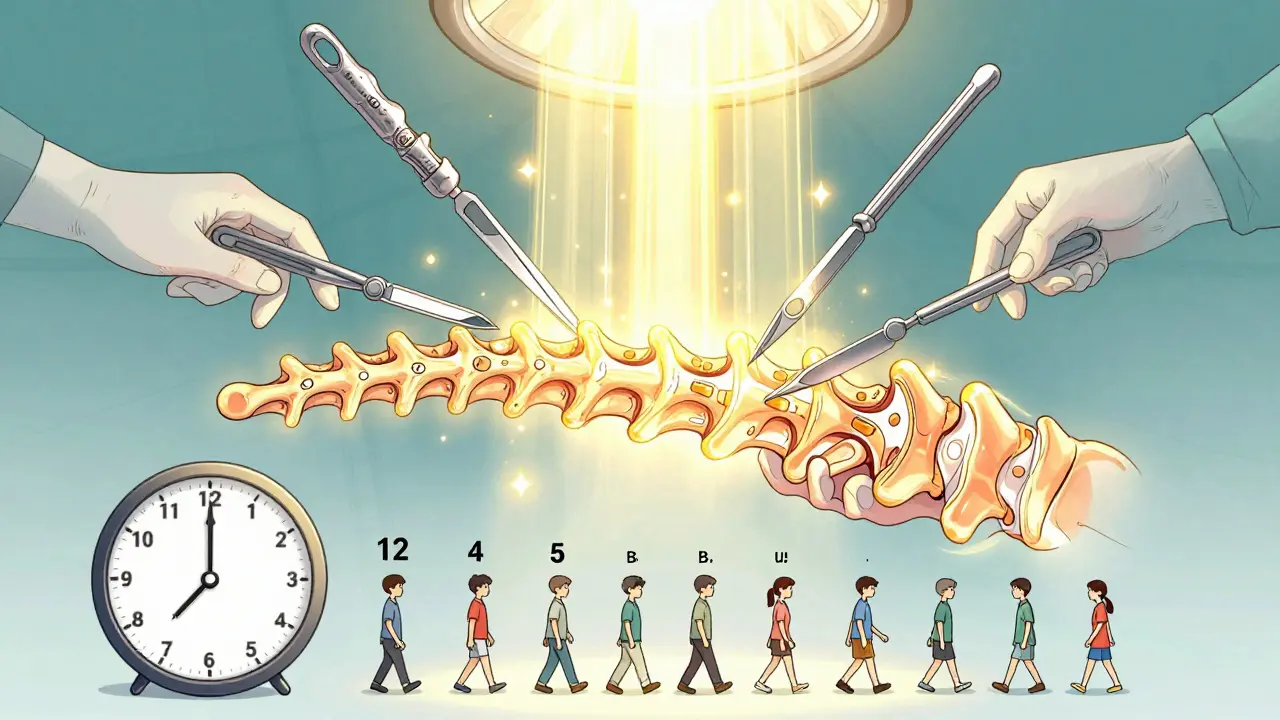
Who Should Avoid Surgery?
Surgery isn’t for everyone. If your symptoms are mild and stable, and your JOA score is 12-14, you might try conservative care-with close monitoring. But if you’re getting worse, even slowly, surgery is the only way to stop it.
Some patients have other health issues that make surgery risky: severe heart disease, uncontrolled diabetes, or advanced age with multiple frailty factors. But age alone isn’t a reason to say no. A 78-year-old in good shape often does better than a 60-year-old with diabetes and smoking history.
Dr. Zorica Buser of the Cleveland Clinic warns that 15-20% of cervical surgeries today might be unnecessary. That’s why proper diagnosis is critical. You need MRI evidence of cord damage, not just stenosis. And you need clear neurological signs-not just pain.
What’s Next in Treatment
Research is moving fast. The CSM-Next trial is testing riluzole, a drug used in ALS, to protect the spinal cord during recovery. Early results show 12% greater improvement in JOA scores when used with surgery.
Genetic markers like COL9A2 polymorphisms are being studied to predict who’ll degenerate faster. That could help decide who needs surgery earlier. Imaging biomarkers are also being developed to detect subtle cord damage before symptoms appear.
The goal isn’t just to operate-it’s to operate at the right time, with the right method, for the right person. Personalized care is the future.
What to Do If You Suspect Cervical Myelopathy
If you’re having hand clumsiness, balance problems, or unexplained weakness, don’t wait. See a spine specialist within two weeks. Get an MRI. Don’t settle for X-rays or a quick "it’s just arthritis" answer.
Most patients see three or more doctors before getting the right diagnosis. The average delay is 14 months. That’s too long. Every day counts. Early intervention can mean the difference between independence and disability.
Don’t assume it’s normal. Don’t wait for pain to get worse. Your spinal cord doesn’t heal well once damaged. Act fast. Get the right test. Talk to a specialist. Your future mobility depends on it.
Can cervical myelopathy get better without surgery?
In mild cases with stable symptoms, some patients may avoid surgery for a time using physical therapy and activity changes. But only about 28% improve over two years. Most-63%-get worse. Surgery is the only proven way to stop progression and restore function in moderate to severe cases.
How do I know if my spinal stenosis has turned into myelopathy?
Spinal stenosis is just narrowing. Myelopathy means the spinal cord is injured. Look for symptoms: hand clumsiness, trouble walking, balance issues, exaggerated reflexes, or bladder urgency. An MRI showing T2 hyperintensity in the cord confirms myelopathy. If you have these signs, it’s not just stenosis-it’s myelopathy.
Is surgery risky for older patients?
Age alone isn’t a barrier. Patients over 70 with good overall health often do very well. Risks come from other conditions-heart disease, diabetes, smoking, or frailty. A 78-year-old in good shape has a better chance than a 60-year-old with uncontrolled diabetes and a smoking habit. The key is medical optimization before surgery.
How long does recovery take after cervical myelopathy surgery?
Hospital stay is usually 1-3 days. Full recovery takes 3-6 months. Hand function often improves first-82% report better dexterity at 12 months. Walking and balance take longer; only 65% regain normal gait. Physical therapy for 8-12 weeks is essential. Patience and consistency matter more than speed.
What’s the success rate of cervical spine surgery for myelopathy?
Success rates vary by procedure. ACDF has 85-90% neurological improvement for single-level cases. Laminoplasty works well for multiple levels at 78-82%. Laminectomy with fusion hits 85%. Overall, 70-85% of patients improve after surgery. The biggest factor? Timing-patients treated within six months of symptoms have 37% better recovery than those who wait over a year.
Can I wait to see if my symptoms get worse before deciding on surgery?
Waiting is dangerous. Cervical myelopathy is progressive. Studies show 20-60% of untreated patients will get significantly worse over 2-5 years. Only 10-15% improve on their own. Every month of delay reduces your recovery potential by about 3%. Once the spinal cord is damaged, it doesn’t heal well. Early surgery gives you the best shot at keeping your independence.
Thomas Varner
January 19, 2026 AT 09:43Renee Stringer
January 20, 2026 AT 22:07Nadia Watson
January 22, 2026 AT 21:46Arlene Mathison
January 23, 2026 AT 01:54Carolyn Rose Meszaros
January 23, 2026 AT 15:20Crystal August
January 23, 2026 AT 18:47Art Gar
January 25, 2026 AT 15:51Emily Leigh
January 26, 2026 AT 11:41Edith Brederode
January 27, 2026 AT 15:04Greg Robertson
January 28, 2026 AT 11:49Courtney Carra
January 29, 2026 AT 22:27