
Lower GI Bleeding Guide: Diverticula, Angiodysplasia, and Diagnosis

| Feature | Diverticular Bleeding | Angiodysplasia |
|---|---|---|
| Blood Volume | Often massive/heavy | Low volume/intermittent |
| Pain Level | Usually painless | Painless |
| Primary Symptom | Sudden hematochezia | Chronic fatigue/anemia |
| Typical Age | 60+ years | 65+ years (mean 72) |
| Recurrence Rate | Lower (many stop spontaneously) | Higher (up to 40% over 2 years) |
The Culprit: Diverticulosis and Bleeding
One of the most frequent causes of sudden, heavy bleeding is Diverticulosis. Now, don't confuse this with diverticulitis; while the latter involves painful inflammation and infection, diverticular bleeding is usually a painless, though alarming, event. To understand why this happens, imagine the wall of your colon. In some spots, the muscle layer is weak, and the inner lining pushes through, creating small pouches called diverticula. Blood vessels (the vasa recti) normally run through the colon wall, but in these pouchy areas, the vessels get pushed right up against the thin surface of the pouch. Over time, these vessels can erode or rupture, leading to a significant amount of blood loss. Interestingly, about 80% of these bleeds stop on their own. However, because the volume can be so high, many patients end up in the hospital for fluid resuscitation and blood transfusions. If the bleeding doesn't stop, doctors can use epinephrine injections or thermal coagulation during a scope to seal the vessel.Understanding Angiodysplasia
If diverticular bleeding is like a burst pipe, Angiodysplasia is more like a slow, leaky faucet. Also known as vascular ectasia, this condition involves the enlargement of small blood vessels in the colon, most commonly in the right side (the cecum). As we age, the veins in the gut can lose their elasticity. The constant movement of the colon causes these vessels to dilate and form tiny, fragile passageways between arteries and veins. Because these leaks are often small, you might not even see bright red blood. Instead, you might just feel exhausted. This is because the slow, constant drip of blood leads to iron deficiency anemia. There is also a strange connection with the heart. People with severe aortic stenosis-a narrowing of the heart valve-often develop angiodysplasia. This happens because the turbulent blood flow through the narrow valve damages a clotting protein called the von Willebrand factor, making the gut vessels even more prone to leaking.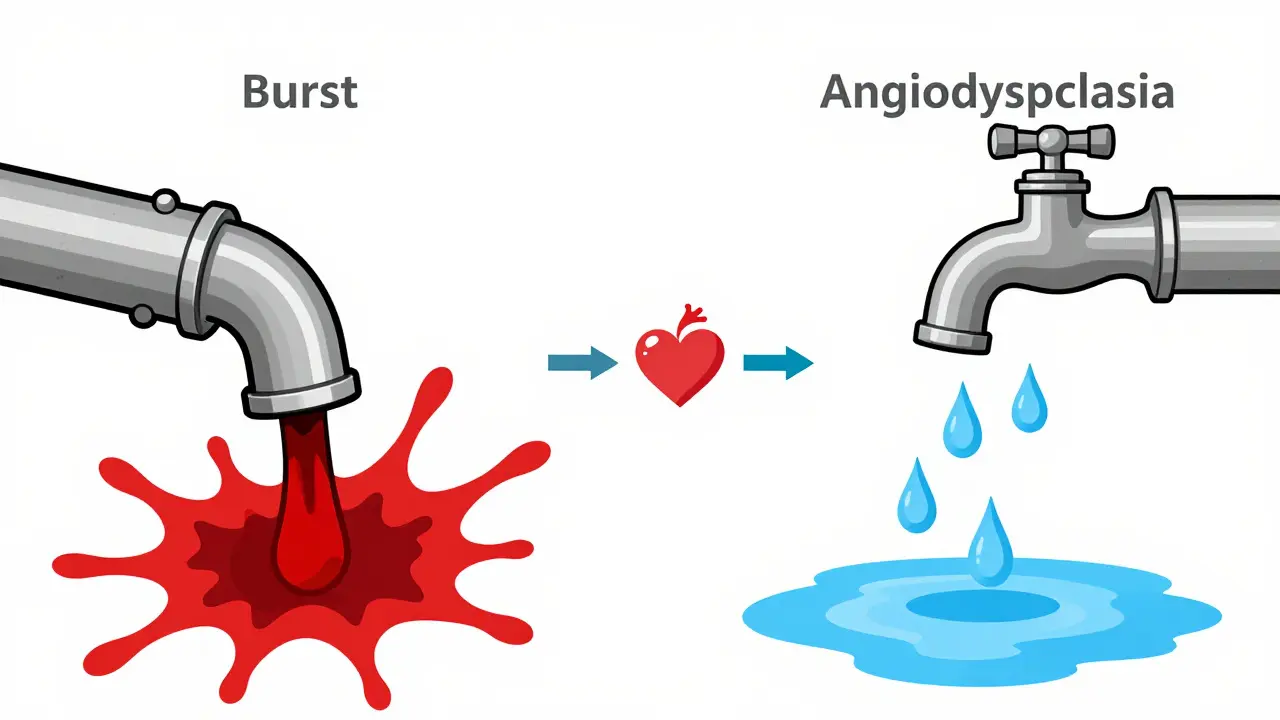
The Diagnostic Workup: Finding the Source
When a patient arrives with lower GI bleeding, the first priority isn't finding the bleed-it's stabilizing the patient. Doctors use the BLEED criteria to figure out who is at high risk for rebleeding. They look at blood pressure (below 100 mmHg is a red flag), the length of the hospital stay, and whether the patient has liver disease or cancer. Once the patient is stable, the search begins. The gold standard is the Colonoscopy. This is a procedure where a camera is threaded through the colon to find the source of the bleed. Timing matters here; performing a colonoscopy within 24 hours can actually reduce mortality rates by about 26% compared to waiting a few days. But what happens if the colonoscopy comes back clean? This is where the "diagnostic odyssey" begins. For "obscure" bleeding, doctors might use:- Capsule Endoscopy: Swallowing a tiny camera pill that takes thousands of photos as it travels through the small intestine. This has a diagnostic yield of about 62%.
- CT Angiography: A high-speed scan that can detect active bleeding if it's happening at a rate of more than 0.5 mL per minute. It's a great tool when a patient is too unstable for a scope.
- Device-Assisted Enteroscopy: Using specialized balloons to navigate the small bowel, which can find the source in up to 71% of tricky cases.
Treatment Options and Long-Term Management
Treatment depends entirely on what is causing the leak. For diverticular bleeds, the approach is often "watch and wait" because they usually resolve. If they don't, endoscopic clipping or thermal cautery is the go-to. In rare, refractory cases, a surgeon might perform a segmental colectomy to remove the problematic section of the colon. Angiodysplasia is a bit more stubborn. The primary treatment is Argon Plasma Coagulation (APC), which uses a stream of ionized gas to cauterize the leaky vessels without touching them. While it works immediately in 80-90% of cases, it's not a permanent cure-many people bleed again within two years. For those with chronic, recurring angiodysplasia, medication can help. Thalidomide (100 mg daily) has shown a 70% success rate in reducing the need for blood transfusions. Another option is octreotide, a medication that reduces blood flow to the gut. If all else fails, a right hemicolectomy is often recommended for lesions in the cecum.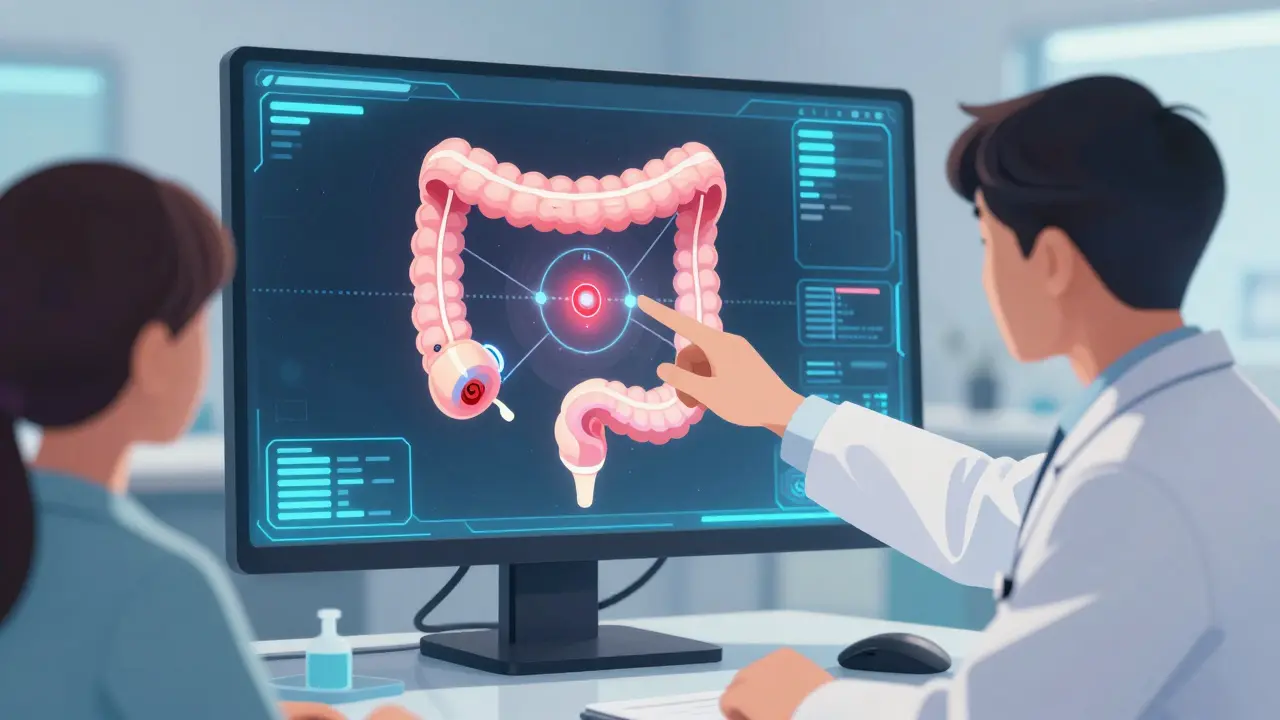
Navigating the Patient Experience
It's worth noting that the experience differs wildly between these two conditions. People with diverticular bleeding often describe a single, scary event that gets fixed and stays fixed. On the other hand, those with angiodysplasia often deal with a long-term struggle. Some patients report spending up to 18 months and undergoing multiple negative colonoscopies before a doctor finally spots the vascular malformations. Modern medicine is trying to close this gap. New AI-assisted colonoscopy tools are now being used to help doctors spot those tiny red vascular lesions that the human eye might miss, increasing detection rates by about 35%.Is lower GI bleeding always a sign of cancer?
No, it is not. While neoplasms (tumors) cause about 10-15% of lower GI bleeds, diverticulosis and angiodysplasia are much more common causes, especially in older adults. However, a colonoscopy is essential to rule out malignancy.
Why does heart disease cause bleeding in the gut?
This specifically happens with aortic stenosis. The narrow heart valve creates turbulent blood flow that shears the von Willebrand factor, a protein necessary for clotting. This deficiency makes the small vessels in the colon more likely to leak, leading to angiodysplasia.
What should I do if I see blood in my stool?
You should seek medical attention immediately. While many causes are benign, massive bleeding can lead to hemodynamic instability. If you feel dizzy, faint, or have a very fast heart rate, go to the emergency room.
How accurate is the BLEED criteria for predicting rebleeding?
The BLEED criteria-which look at blood pressure, hospital stay, endoscopic signs, and comorbidities-have been shown to predict the risk of rebleeding with approximately 87% accuracy.
Can angiodysplasia be cured permanently?
It's difficult to "cure" permanently because the underlying vessel degeneration is related to aging. Treatments like Argon Plasma Coagulation provide immediate relief, but recurrence rates are high. Surgical removal of the affected segment is the most definitive option but carries more risk.
Jon Moss
April 23, 2026 AT 19:42It's really sobering to think about how much the body changes as we age and how these things just happen without any warning.
Andre Ojakäär
April 24, 2026 AT 01:08obviously the heart connection is the real kicker here... like imagine your heart valve just deciding to ruin your gut stability... absolutely wild stuff
Edwin Perez
April 25, 2026 AT 22:54Funny how they push the capsule endoscopy. Just a pill with a camera. Who knows what they're actually tracking or where that data goes once it leaves your colon.
Beena Garud
April 27, 2026 AT 11:35The duality between the acute trauma of a diverticular bleed and the slow, existential erosion of angiodysplasia reflects the broader human experience of suffering. One is a sudden storm, the other a gradual tide that wears away the spirit through fatigue and anemia, mirroring how we face mortality in different stages of our biological decline. It is a profound testament to the fragility of the vascular system that a mere change in heart valve pressure can manifest as a gastrointestinal crisis, bridging the gap between the central pump and the distal periphery of our existence. We are, in essence, a series of interconnected pipes and valves, where a failure in one sector inevitably echoes in another, reminding us that no part of the self is truly autonomous. This systematic diagnostic approach is not merely medical, but a philosophical exercise in mapping the decay of the physical form. Such a structured plan allows the patient to transition from a state of visceral panic to one of cognitive understanding. This transition is essential for maintaining dignity in the face of bodily betrayal. To treat the symptom without acknowledging the fragility of the vessel is to ignore the poetry of aging. Ultimately, the medical gaze seeks a leak to plug, while the thinking mind seeks to understand why the vessel failed in the first place. The search for a source of bleeding is, in a way, a search for the origin of our own vulnerability. We navigate these diagnostic odysseys not just for health, but for the certainty that we are being seen and understood by the science of our time. The integration of AI into this process suggests a future where the human eye is no longer the limit of our perception, yet the fear remains deeply human. We are biological machines tending to our own malfunctions.
Anand Mehra
April 28, 2026 AT 14:53bleeding criteria is just a guess. 87% accuracy is mid for medical standards. basically a coin flip if you're unlucky
Hayley Redemption
April 29, 2026 AT 14:06The mention of thalidomide is almost quaint. I assume the author expects us to be impressed by a 70% success rate, but in a clinical setting with refractory cases, that's hardly a triumph of modern medicine.
Ben Jima
April 30, 2026 AT 05:26If anyone is feeling overwhelmed by the diagnostic process, just remember that the goal is stability first. Take it one step at a time and keep a detailed log of your symptoms to help your doctor!
Daniel Runion
May 1, 2026 AT 11:39Wait... so we're just supposed to "watch and wait" for diverticular bleeds??? That is absolutely insane!!! Who in their right mind thinks that's a viable strategy for a massive hemorrhage??? Unbelievable!!!
Nikita Shabanov
May 1, 2026 AT 18:39For those who have had a negative first colonoscopy, don't panic. It's quite common for these lesions to be missed because they are so small and blend in with the mucosa.
Gauri Parab
May 3, 2026 AT 04:20The irony of calling it a "diagnostic odyssey" is that for most people, it's just a series of expensive failures before they find the obvious. The 62% yield for capsule endoscopy is laughable when you consider the cost and discomfort.
Kristen O'Neal
May 4, 2026 AT 14:37I actually find the AI-assisted tools really promising. If it can increase detection by 35%, that's a huge win for patients who have spent months in that "odyssey" without an answer.
William Zhigaylo
May 5, 2026 AT 18:01It is absolutely abhorrent that some clinicians would allow a patient to linger in a state of anemia for eighteen months before achieving a diagnosis. This is a gross failure of the medical establishment!
Carol Yang
May 7, 2026 AT 13:11Glad to see there are options like the camera pill, sounds way easier than some of the other stuff.
sachin singh
May 9, 2026 AT 10:30The explanation regarding the von Willebrand factor is quite enlightening. It provides a clear mechanical link between cardiac pathology and intestinal bleeding.
Michael Chukwuma
May 9, 2026 AT 21:03I agree, the heart-gut connection is really the most surprising part of this whole thing.