
Leukemia and Lymphoma: Targeted and Cellular Therapies Revolutionizing Cancer Care

For decades, leukemia and lymphoma were treated with the same blunt tools: chemotherapy, radiation, and sometimes stem cell transplants. These approaches often left patients weakened, sick for months, and still at high risk of relapse. But since 2001, a quiet revolution has been underway. Today, targeted therapy and CAR T-cell therapy are changing the game-offering real hope, even for patients who ran out of options.
How Targeted Therapies Work: Hitting Cancer’s Weak Spots
Targeted therapies don’t attack all fast-growing cells like chemo does. Instead, they zero in on specific proteins or genes that cancer cells rely on to survive. Think of it like disabling the engine of a car instead of smashing the whole vehicle. For chronic lymphocytic leukemia (CLL) and small lymphocytic lymphoma (SLL), two key drugs dominate: ibrutinib and venetoclax. Ibrutinib blocks a protein called Bruton tyrosine kinase (BTK), which cancer cells use to send survival signals. Taken as a daily pill, it keeps the disease in check for years. Venetoclax goes after BCL-2, a protein that tells cancer cells not to die. When combined with other drugs, it can push some patients into deep remission-sometimes lasting years without further treatment. These drugs aren’t magic. Resistance can develop. Some patients have mutations like del(17p) or TP53 that make them less responsive. But even then, targeted therapies have improved outcomes dramatically. In the past, patients with high-risk CLL lived about two years after diagnosis. Now, many live over a decade. And the time it takes for CLL to turn into aggressive lymphoma (called Richter transformation) has doubled-from 2.2 years to 4.9 years-thanks to these drugs.CAR T-Cell Therapy: Rewiring Your Immune System to Fight Cancer
If targeted therapy is like a precision missile, CAR T-cell therapy is like training your own army. Here’s how it works: First, doctors collect your T cells-the immune cells that normally hunt down invaders. Then, in a lab, they add a synthetic receptor called a chimeric antigen receptor (CAR). This new receptor lets your T cells recognize and destroy cancer cells that carry the CD19 protein, a marker found on most B-cell lymphomas and leukemias. The modified cells are multiplied in the lab-sometimes billions of them-then infused back into your body. Within weeks, these engineered soldiers start attacking cancer cells. In some cases, the cancer disappears completely. The first CAR T-cell therapy, tisagenlecleucel (Kymriah), was approved in 2017 for children with acute lymphoblastic leukemia. Today, therapies like Yescarta (axicabtagene ciloleucel) and Breyanzi (lisocabtagene maraleucel) are used for adults with relapsed or refractory large B-cell lymphoma. Real-world data shows that 42.6% of patients treated with Yescarta in second-line therapy are still alive four years later. That’s unheard of just a decade ago. Newer versions are even more advanced. Gilead’s KITE-363 and KITE-753 target both CD19 and CD20 at the same time. This dual-target approach reduces the chance that cancer cells will escape by losing one marker. Early results show a 63.6% complete remission rate in patients who had failed other treatments.When to Use Which Therapy? A Practical Guide
Choosing between targeted therapy and CAR T-cell therapy isn’t about which is “better.” It’s about timing, health, and goals. Targeted therapies are often used first. They’re oral pills, taken at home. No hospital stay. No intensive monitoring. They’re ideal for older patients or those with other health issues. But they’re not usually curative. Most patients eventually develop resistance, and progression-free survival typically lasts 3-5 years. CAR T-cell therapy is reserved for when targeted drugs stop working-or for patients with very aggressive disease. It’s a one-time infusion, but it requires a hospital stay for at least a week. Why? Because of serious side effects. Cytokine release syndrome (CRS) is common. Your immune system goes into overdrive, causing high fever, low blood pressure, and breathing trouble. Neurotoxicity can lead to confusion, seizures, or trouble speaking. About 20-40% of patients experience these. But hospitals now have protocols to manage them quickly, and survival rates from these complications are high when treated early. Cost is another factor. A single CAR T-cell treatment runs $373,000 to $475,000. Targeted drugs like venetoclax cost $15,000-$25,000 per month. Insurance covers most of it, but out-of-pocket costs can still be crushing.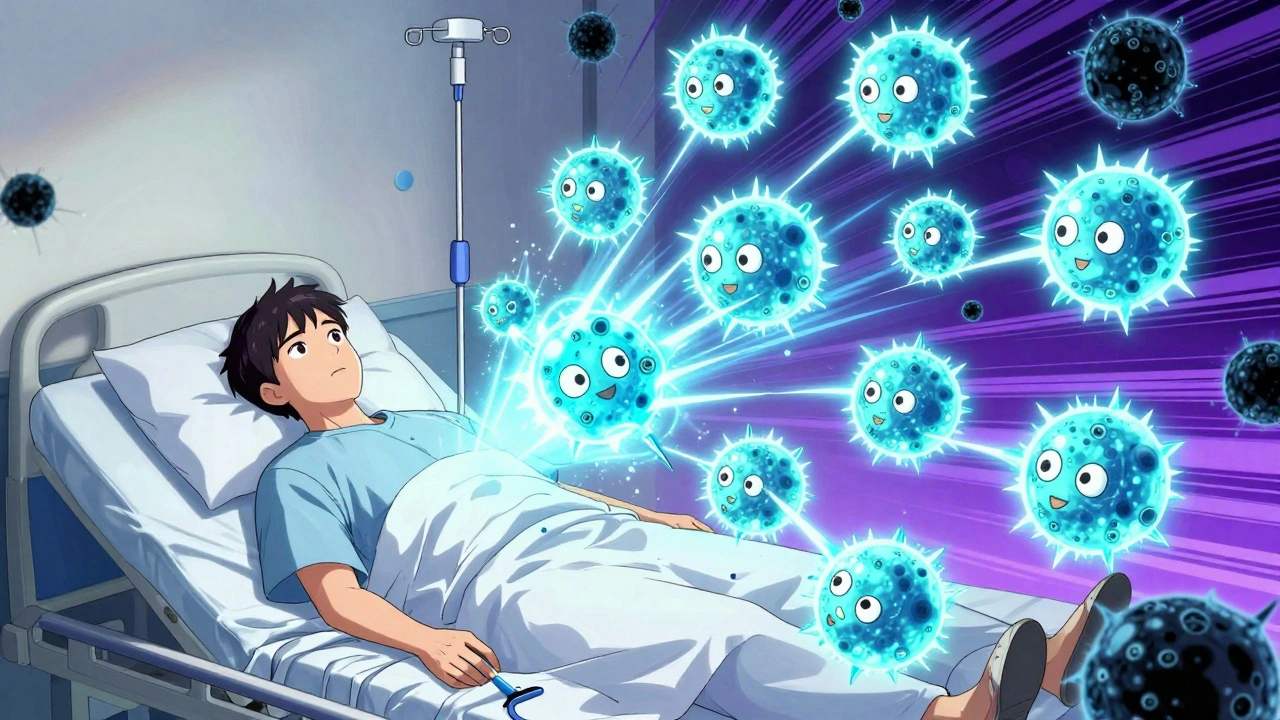
What’s Next? The Future Is Already Here
The field is moving fast. In 2025, the FDA granted priority review to liso-cel for marginal zone lymphoma-a new indication that could expand access. And research is pushing these therapies earlier in treatment. A 2025 ASCO survey found that 68% of hematologists believe CAR T-cell therapy will become a first-line option for high-risk lymphoma patients by 2030. That’s a massive shift. Right now, it’s used only after other treatments fail. But early trials show better outcomes when used sooner. Newer CAR T designs are being tested to work outside hospitals. Some use “off-the-shelf” cells from donors instead of the patient’s own cells. That cuts manufacturing time from 3-5 weeks to days. Others are being engineered to be more stable, reducing the risk of long-term immune damage. Even the way we measure success is changing. Doctors now look for minimal residual disease (MRD)-tiny traces of cancer left after treatment. If MRD is undetectable, the chance of long-term remission jumps dramatically. This isn’t just about shrinking tumors anymore. It’s about erasing the cancer’s footprint.Challenges That Still Remain
Despite all the progress, big problems linger. Access is uneven. About 89% of NCI-designated cancer centers offer CAR T-cell therapy. But only 32% of community hospitals do. That means patients in rural areas often have to travel hundreds of miles-and wait weeks for a slot. Manufacturing is slow. It takes 3-5 weeks to grow CAR T cells. For someone with fast-growing lymphoma, that delay can be deadly. Labs are working on faster methods, but it’s still a bottleneck. And then there’s cost. Even with insurance, patients face financial toxicity. One patient described paying $20,000 a month out of pocket for targeted drugs while waiting for CAR T approval. That’s not just a medical issue-it’s an ethical one. Doctors are also learning how to sequence treatments. Should you use a BTK inhibitor first, then a BCL-2 inhibitor, then CAR T? Or combine them upfront? There’s no single answer yet. Clinical trials are testing combinations, but real-world data is still catching up.
Lara Tobin
December 13, 2025 AT 17:33Jamie Clark
December 14, 2025 AT 05:58Keasha Trawick
December 15, 2025 AT 00:47Bruno Janssen
December 16, 2025 AT 22:22Emma Sbarge
December 17, 2025 AT 07:09Deborah Andrich
December 18, 2025 AT 12:43Tommy Watson
December 19, 2025 AT 18:33Casey Mellish
December 21, 2025 AT 10:28