
Healthcare Drug Spending: How Generic Medicines Control Costs
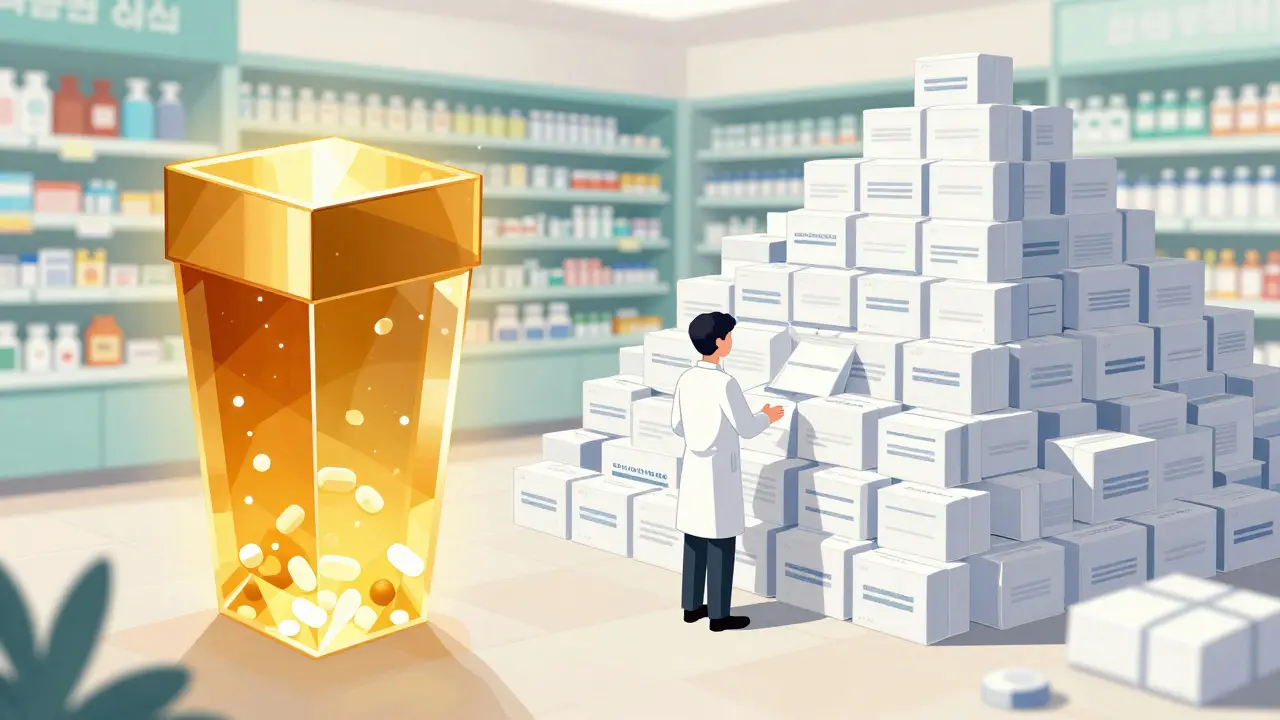
Consider this: in 2024, brand-name drugs made up only 10% of all prescriptions filled in the United States, yet they consumed 88% of the total money spent on medication. Meanwhile, generic medicines handled the other 90% of prescriptions while accounting for just 12% of the spending. That massive imbalance isn't just an accounting curiosity; it represents the difference between paying hundreds of dollars for a heart pill versus a few dollars. If you are trying to understand why your pharmacy bill keeps climbing, or how systems actually try to bring those numbers down, the answer lies almost entirely in the world of generic drugs, which are chemically identical versions of brand-name drugs that become available after patent expiration. These medications are priced significantly lower-typically 80-85% cheaper than their branded counterparts-while providing the same therapeutic efficacy. They are the engine of healthcare affordability. Without them, the system would grind to a halt. So, let's look at exactly how they work, where the roadblocks are, and what we can realistically expect looking forward to 2026.
The Science Behind the Savings
Many people assume generics are "lesser" versions of the original drug, but the regulatory science says otherwise. To get approved, a generic manufacturer has to prove two main things to the regulator. First, pharmaceutical equivalence. This means the active pharmaceutical ingredient(API) must be identical to the reference product in strength, dosage form, and route of administration. Second, bioequivalence. This is tested through rigorous studies involving healthy volunteers where blood samples are taken at multiple points over 72 hours. The results must show that the generic drug gets into the bloodstream at nearly the same speed and amount as the brand drug-specifically within a confidence interval of 80-125%.
This process ensures that if a doctor prescribed a specific statin or antihypertensive, the generic version works on your body in the exact same way. The Food and Drug AdministrationFDAmaintains strict standards for this, listing over 14,000 approved products in their Orange Book. While inactive ingredients like fillers or dyes might vary slightly-which can sometimes cause minor differences in appearance or smell-they do not affect how well the medicine treats the condition. The savings come because generic companies don't have to re-pay for the initial billions of dollars in research and development required to discover the molecule originally. They simply replicate it once safety is established.
The Economic Engine: Patents and Pricing
The reason generics are cheap is largely due to the laws governing intellectual property. The landscape was shaped by the Hatch-Waxman Actpassed in 1984, which established a pathway for abbreviated new drug applications (ANDAs). Before this act, companies had to run full clinical trials even for copycats, which kept prices high. Now, once a patent expires, competition kicks in immediately. When that happens, the average price drops by roughly 85%. It is a dramatic shift.
You might notice, however, that the transition isn't always instant. We often see something called a "patent cliff." While one company holds the patent, they sell the drug at a premium price. As soon as the exclusivity ends, multiple competitors enter the market. The more competitors there are, the lower the price gets. One study notes that each additional generic entrant reduces prices by another 11-15%. This dynamic is crucial for public health policy. If a drug goes off-patent but no generic enters within a year, prices remain dangerously high. The goal of modern health economics is to ensure that competition actually arrives when the patent clock hits zero.
Beyond Small Molecules: The Biosimilar Frontier
Not every drug is a simple chemical pill. There is a growing category of complex biological medicines, often large protein-based treatments for conditions like cancer, rheumatoid arthritis, or diabetes. These require a different approach known as biosimilarscomparable alternatives to complex biologic drugs that typically offer 15-35% discounts versus reference biologics. Developing these is harder than making standard generics. Because biological molecules are manufactured in living cells rather than built by chemical synthesis, they cannot be identical copies. Instead, they are "highly similar" with no clinically meaningful differences.
This distinction creates what experts call the "biosimilar void." In small molecule drugs (like aspirin or metformin), generics compete within a year of patent expiry 92% of the time. For biologics, about 90% of drugs losing protection in the next decade currently have zero biosimilar competitors in the pipeline. This is a major gap in cost control. A biologic can cost thousands of dollars a month, whereas a biosimilar brings that number down, but the development hurdles are steep. Regulatory agencies have launched action plans to speed up approvals, hoping to make these biologics affordable for chronic patients, especially those relying on insulin or autoimmune therapies.
Hidden Barriers to Lower Costs
If the logic is sound-competition lowers prices-why do costs still feel high? It turns out there are artificial barriers designed to keep competition away. Brand manufacturers often file hundreds of patents on a single drug, covering everything from the formula to the shape of the packaging. This is known as a "patent thicket," where manufacturers file 140+ patents on average to extend market exclusivity. They also use "pay-for-delay" settlements, essentially paying generic companies to stay off the market. The Federal Trade Commission found these agreements delayed generic entry by 17 months on average, costing consumers billions.
Supply chains add another layer of complexity. Most active ingredients for generic drugs are manufactured overseas, primarily in China and India. During the global disruptions of 2020-2022, this vulnerability was exposed, leading to shortages of over 300 essential medicines. A generic pill might be cheap, but if there is none in stock, the hospital must switch to a brand-name alternative at a fraction of the profit margin. Furthermore, pharmacy benefit managersPBMs handle negotiations between insurers and pharmacies, sometimes creating confusing rebate structures that make generics seem expensive to the patient even when the base cost is low. This leads to scenarios where a patient sees a higher copay for a generic because of specific insurance contracts, which defeats the purpose of the drug being available.
The Patient Experience: Is It Worth Switching?
For individuals managing their own health, the decision to take a generic often comes down to trust and finances. Data from GoodRx shows that 68% of patients reported skipping doses when they couldn't afford medication, but switching to a generic usually solves that. A real-world example involves insulin users who switched from brand Humalog to generic insulin lispro. They saw their monthly cost drop from $350 to $25, allowing them to continue therapy rather than rationing shots. This financial relief translates directly to better health outcomes.
However, the experience isn't perfect for everyone. About 23% of patients report negative experiences when switched to a generic for "narrow therapeutic index" drugs, such as thyroid medications or seizure drugs. With these sensitive medicines, even tiny variations in absorption rates can matter. Patients need to know that while therapeutic equivalence is statistically required, individual physiology varies. If you feel symptoms returning after a switch, it does not necessarily mean the generic failed; it might mean your body needs a consistent source. Open communication with your prescriber remains key here. Generally, patient reviews show generics maintain high ratings for efficacy, scoring just below brand-name drugs, but vastly outperforming them on affordability scores.
| Feature | Brand-Name | Generic |
|---|---|---|
| Average Cost | $1,000+ | 15-20% of Brand Price |
| Market Share by Volume | 10% | 90% |
| Development Time | 10-15 years | 1-2 years |
| Active Ingredients | Original Molecule | Identical |
| Regulatory Approval | NDA (Full Clinical Trials) | ANDA (Bioequivalence Study) |
Policy Shifts and Future Outlook
As we move through 2025 and 2026, the government is playing a bigger role in pricing. New legislation, such as the Inflation Reduction Act provisions in the U.S., allows Medicare to negotiate prices directly with manufacturers for certain high-cost drugs. Early projections suggest this could save the federal budget hundreds of billions of dollars over a decade. However, experts argue that negotiation alone cannot match the efficiency of competition. The Congressional Budget Office emphasizes that generic substitution produces greater savings per drug than price negotiation, particularly for older, off-patent products.
Looking ahead, the focus is shifting toward fixing the "supply chain risk." Manufacturers are encouraged to diversify production locations so that a shortage in one country doesn't starve another. Technology is also evolving; advanced manufacturing techniques might eventually allow complex biologics to be produced more cheaply, shrinking the gap between brand and biosimilar further. The ultimate goal is a healthcare economy where access to life-saving treatment is determined by medical need, not by the color of the logo on the bottle.
Tony Yorke
March 28, 2026 AT 04:46This breakdown effectively highlights the massive disparity between prescription volume and spending.
Sabrina Herciu
March 29, 2026 AT 13:00Important! Very clear explanation! The bioequivalence section was! Extremely useful! Thank you! 👍
tyler lamarre
March 30, 2026 AT 16:04The statistical limits on bioequivalence often mask real clinical variance! Most laymen misunderstand this nuance.
Rohan Kumar
April 1, 2026 AT 04:03Patent thickets are basically corruption disguised as law 🙄💊 Big pharma laughing all the way to the bank.
gina macabuhay
April 2, 2026 AT 22:59It is unacceptable that lives depend on market manipulation! We demand ethical practices now! Do not accept excuses!
Monique Ball
April 4, 2026 AT 17:01It is truly wonderful to see such detailed analysis shared! Many folks feel hopeless regarding healthcare costs today. But the data clearly shows progress is possible! We must remember that competition works wonders. Even the patent cliff concept helps stabilize markets eventually! Every new entrant lowers prices significantly for families. And we cannot forget the patients who saved money recently! Their stories are genuinely inspiring to read about! The FDA standards protect us from unsafe alternatives! Safety remains the priority above all financial metrics! We should encourage more innovation in biosimilars. Technology is moving faster than legal bureaucracy! Soon the void will be filled with affordable options. Everyone deserves access to life-saving medication without debt. Let us stay hopeful for a brighter healthcare future! 🌟✨
Austin Oguche
April 5, 2026 AT 15:23Global trade dynamics play a large role here. We must balance security with affordability carefully. Production localization is key.
Debra Brigman
April 7, 2026 AT 00:24The commodification of healing is a bitter pill indeed. We swallow more than just tablets sometimes.
Aaron Olney
April 8, 2026 AT 11:47You aright though. its scary how they control us. my mom had insuline issue last year 😬
Jeannette Kwiatkowski Kwiatkowski
April 9, 2026 AT 22:53Honestly, people complain too much. If you want cheap meds, just move somewhere else. Stop blaming big corps.
Poppy Jackson
April 10, 2026 AT 03:20That is incredibly insensitive! Not everyone has mobility options! Love and support go a long way.