
Generic Combinations vs. Individual Generics: How to Save Money on Medications
You walk into the pharmacy with a prescription for a generic medication. You expect it to be cheap. That’s the whole point of generics, right? But lately, that assumption is cracking. Prices for some generic drugs have skyrocketed, sometimes costing more than you’d pay for a brand-name alternative or a different generic formulation entirely. It feels like a glitch in the system, but it’s actually a feature of a fragmented market. The good news is that you don’t have to accept these inflated prices as inevitable.
There is a significant opportunity for cost savings from generic combinations and strategic substitutions that most patients and even some healthcare providers miss. By understanding the difference between individual generics, combination products, and therapeutic alternatives, you can often slash your out-of-pocket costs by nearly 90% without sacrificing clinical effectiveness. This isn't about cutting corners; it's about navigating the complex economics of the pharmaceutical supply chain to get the best value for your health.
The Hidden Cost of "Generic" Drugs
We tend to think of "generic" as a single price tier-low cost. In reality, the generic market is wildly inconsistent. A pivotal study published in JAMA Network Open (November 2022) by researchers including Gerard F. Anderson from Johns Hopkins highlighted this disparity. They analyzed the top 1,000 generics in Colorado’s all-payer claims database and found 45 high-cost generics that had lower-cost therapeutic alternatives with equivalent clinical value.
The numbers are staggering. These high-cost generics were, on median, 15.6 times more expensive than their cheaper alternatives. If patients had simply switched to the lower-cost option, total spending would have dropped from $7.5 million to just $873,711-a potential savings of 88.3%. Most of these overpriced generics weren’t even different drugs; they were just different dosage forms or strengths of the same medication. For example, switching dosage forms yielded mean discounts of nearly 95%, while changing strengths saved an average of 77%. The takeaway is clear: not all generics are created equal when it comes to price, even if they are identical in effect.
Combination Products vs. Individual Generics
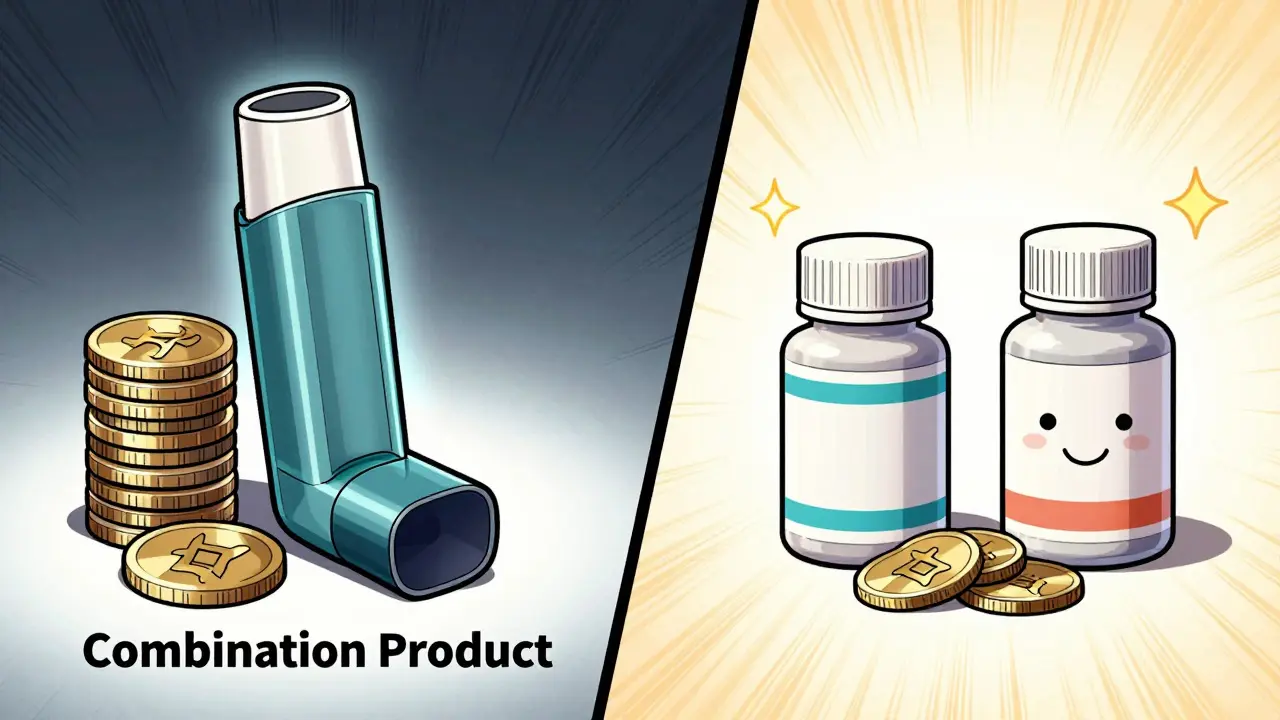
One specific area where costs spiral is with combination products. These are medications that combine two active ingredients into one pill or inhaler, designed for convenience. While convenient, they often carry a premium price tag compared to buying the two components separately as individual generics.
| Medication Type | Example Scenario | Estimated Monthly Cost | Savings Potential |
|---|---|---|---|
| Brand-Name Combination | Advair Diskus (ICS/LABA) | $334 | Baseline |
| Generic Combination | Wixela Inhub (Generic ICS/LABA) | $115 | 65.6% reduction vs. Brand |
| Two Individual Generics | Separate Fluticasone + Salmeterol | $40 - $60* | ~50-60% reduction vs. Generic Combo |
A 2022 study documented that the introduction of generic ICS/LABA drugs, specifically Wixela Inhub as an alternative to Advair Diskus, led to estimated annual cost savings of $941 million. The monthly prescription cost for the combined market dropped from $337 million to $233 million after the generic became available. However, splitting the therapy into two separate generic inhalers could often yield even deeper savings, provided the patient can manage two devices instead of one. The trade-off is always convenience versus cost. For many, saving hundreds of dollars a year makes the extra step worth it.
Therapeutic Alternatives: The Smart Swap
Sometimes, the cheapest option isn't a generic version of your current drug at all-it’s a completely different drug that does the same job. These are called therapeutic alternatives. Dr. Melinda Buntin, a health economist at Johns Hopkins, notes that therapeutic substitution provides a simple pathway to offer the same benefit at a lower cost.
Consider blood pressure medications. You might be prescribed a high-cost generic ACE inhibitor. However, there may be a thiazide diuretic or a calcium channel blocker available for pennies on the dollar that achieves the same blood pressure control. The FDA’s Orange Book helps identify which generics are therapeutically equivalent to reference listed drugs, marked with an 'A' rating. But finding true therapeutic alternatives requires a conversation with your prescriber. They need to know that cost is a barrier and that you’re open to trying a different class of medication if it’s clinically appropriate.
The Association for Accessible Medicines reported that in 2023 alone, the 10 most dispensed generic medicines accounted for $89.5 billion in savings. Crestor generics, for instance, reduced costs from $5.78 to $0.08 per unit-a 99% savings. Prilosec generics saw a similar 98% drop. These aren’t outliers; they are proof that competition drives prices down. When multiple manufacturers enter the market, prices plummet. Markets with three or more competitors see price reductions of about 20% within three years, with further declines as competition heats up.
Why Are Some Generics So Expensive?
If generics are supposed to be cheap, why do we still see high prices? Several factors contribute to this anomaly:
- Market Consolidation: The top 10 generic manufacturers control approximately 40% of the $70 billion U.S. generic drug market. With fewer players, there is less competitive pressure to keep prices low.
- Patent Thickets: Some companies file numerous minor patents around a drug to delay generic entry or limit competition among existing generics.
- Supply Chain Fragility: Generic drug shortages rose from 166 in 2012 to 258 in 2022. When supply is tight, remaining manufacturers can raise prices.
- Lack of Transparency: Patients rarely see the wholesale price. We see the copay, which is determined by Pharmacy Benefit Managers (PBMs) and formulary tiers, not necessarily the actual cost of the drug.
This lack of transparency means you might be paying a higher copay for a "preferred" generic that is actually more expensive for the insurer than a non-preferred, cheaper alternative. Plan sponsors and PBMs often fail to update formularies frequently enough to reflect these price shifts.
How to Identify Savings Opportunities
You don’t need to be a pharmacist to spot these opportunities. Here is a practical checklist to use at your next doctor’s visit or pharmacy fill:
- Ask About Splitting Therapies: If you are on a combination pill (like for blood pressure or diabetes), ask if taking two separate generic pills is cheaper. Calculate the math yourself using online drug price checkers.
- Request a Formulary Check: Ask your pharmacist, "Is there a lower-tier generic alternative to this medication?" Pharmacists have access to real-time pricing data that patients do not.
- Discuss Therapeutic Alternatives: Tell your doctor, "I am concerned about the cost of this medication. Are there other drugs in the same class that are more affordable?" Doctors appreciate this honesty and will often switch you to a equally effective, cheaper option.
- Use Price Comparison Tools: Websites like GoodRx or Mark Cuban’s Cost Plus Drug Company provide transparent pricing. A 2023 study in JAMA Health Forum found that Mark Cuban’s model offered median savings of $4.96 per prescription, with uninsured individuals saving up to $6.08 per fill.
- Review Dosage Forms: Sometimes a liquid suspension costs significantly more than a tablet, or a 10mg pill costs more than two 5mg pills. Ask if a different strength or form is available.

The Role of Insurance and PBMs
Your insurance status plays a huge role in how much you save. The JAMA Health Forum study analyzing millions of prescriptions found that savings varied significantly by insurance type. Uninsured individuals saw the highest absolute savings because they paid the full negotiated price. Military beneficiaries saw median savings of $5.05, Medicare patients $4.64, and those with private insurance $3.69. Medicaid recipients showed no observed savings in this specific analysis, likely due to strict government-negotiated pricing caps that already keep costs low.
Pharmacy Benefit Managers (PBMs) act as intermediaries between insurers and pharmacies. They negotiate rebates and set formulary tiers. Sometimes, a PBM will steer you toward a slightly more expensive generic because they receive a larger rebate from the manufacturer, not because it’s the lowest cash price. This misalignment of incentives is a key reason why patients often don’t get the cheapest option automatically. Advocating for yourself by asking for the "lowest cost option" forces the system to work for you, not against you.
Future Outlook: Biosimilars and Continued Competition
The landscape is evolving. As biologic drugs (complex proteins used for conditions like rheumatoid arthritis and Crohn’s disease) lose patent protection, biosimilars are entering the market. The first wave of biosimilars for blockbuster drugs like Humira entered the market in 2023, promising similar cost-reduction dynamics to small-molecule generics. The Department of Health and Human Services projects that generic and biosimilar competition could generate an additional $1.2 trillion in savings over the next decade.
However, challenges remain. The FDA approved 724 Abbreviated New Drug Applications (ANDAs) in fiscal year 2023, a decline from the peak in 2017. Regulatory hurdles and manufacturing complexities slow down new entrants. Despite this, generics still represent 90% of all prescriptions dispensed in the U.S., accounting for only 23% of total drug spending according to 2023 IQVIA data. This dominance proves that when competition works, it works incredibly well.
To maximize your savings, stay informed. Don’t assume the first generic offered is the best deal. Ask questions, compare options, and work with your healthcare team to find the most economical path to better health. The system is imperfect, but with a little effort, you can navigate it effectively.
Are generic combinations always cheaper than individual generics?
Not always. While combination products offer convenience, they often carry a premium. Buying two separate generic medications can sometimes be significantly cheaper than one combination pill, though it requires managing two prescriptions. You should calculate the total cost of both options to determine the best value.
What is a therapeutic alternative?
A therapeutic alternative is a different drug that treats the same condition but may have a different mechanism of action or chemical structure. For example, switching from a high-cost generic ACE inhibitor to a low-cost generic thiazide diuretic for blood pressure control. These swaps require a doctor's approval but can lead to substantial savings.
Why are some generic drugs so expensive?
High generic prices are often caused by market consolidation, where few manufacturers dominate the supply, reducing competition. Other factors include patent thickets, supply shortages, and lack of pricing transparency between manufacturers, PBMs, and insurers.
How can I find the cheapest generic for my prescription?
Ask your pharmacist for the lowest-tier generic option available. Use online price comparison tools like GoodRx or check if your insurance plan covers discount programs. Additionally, discuss with your doctor whether a different dosage form or a therapeutic alternative might be more affordable.
Do biosimilars offer similar savings to generics?
Yes. Biosimilars are highly similar versions of biologic drugs. As they enter the market, such as the recent biosimilars for Humira, they drive down costs similarly to traditional generics. The HHS projects billions in future savings from increased biosimilar competition.