
Earwax Impaction: How to Recognize and Safely Remove Cerumen Blockage

It’s not just an old wives’ tale-your ear doesn’t need cleaning. In fact, trying to clean it often makes things worse. Earwax, or cerumen, isn’t dirt. It’s a natural, protective substance made by glands in your ear canal. It traps dust, repels water, and keeps bacteria out. But sometimes, it builds up too much. When it hardens and blocks the ear canal, that’s called earwax impaction. And it’s more common than you think.
How Do You Know If You Have an Impaction?
You might not realize it at first. Earwax impaction doesn’t always hurt. But when it does, the symptoms are hard to ignore. About 65% of people with impacted earwax notice their hearing seems muffled, like they’re underwater. Others feel pressure or fullness in the ear, even if nothing’s stuck inside. Dizziness, ringing in the ears (tinnitus), or even a persistent cough can show up too. That’s right-a cough. The nerve that runs through the ear connects to your throat, and pressure from wax can trigger it.Drainage or a bad smell from the ear? That’s a red flag. It could mean the wax has trapped moisture and caused an infection. These symptoms usually build up slowly over one to three weeks. Most people don’t notice until they have at least two of them happening together.
Here’s the catch: not all earwax needs to be removed. Around 30-40% of people have visible wax during routine checkups, but if they don’t have symptoms, doctors leave it alone. The ear is designed to clean itself. Jaw movement, like chewing, slowly pushes wax out. You only need to step in when it’s causing problems.
What Causes Earwax to Get Blocked?
The biggest cause? You. Specifically, cotton swabs. The NHS estimates that 60-70% of earwax impactions are caused by people trying to clean their ears with Q-tips. Pushing the swab in doesn’t remove wax-it shoves it deeper, packing it against the eardrum like a cork. The more you dig, the tighter it gets.Other common culprits:
- Hearing aids and earbuds-worn daily, they block the ear’s natural cleanup system. About 35-40% of hearing aid users develop impaction.
- Excessive ear hair-especially in men over 50. Hair can trap wax and slow its exit.
- Abnormal ear canal shape-some people are born with narrow or curved canals that make wax harder to clear.
- Aging-your earwax gets drier and stickier as you get older. The CDC found that while only 5% of adults 20-40 have impaction, that jumps to 14% over age 65.
It’s not just about age or anatomy. If you’ve had ear surgery, a perforated eardrum, or chronic ear infections, your risk goes up. That’s why home remedies can be dangerous.
What NOT to Do: The Dangerous Myths
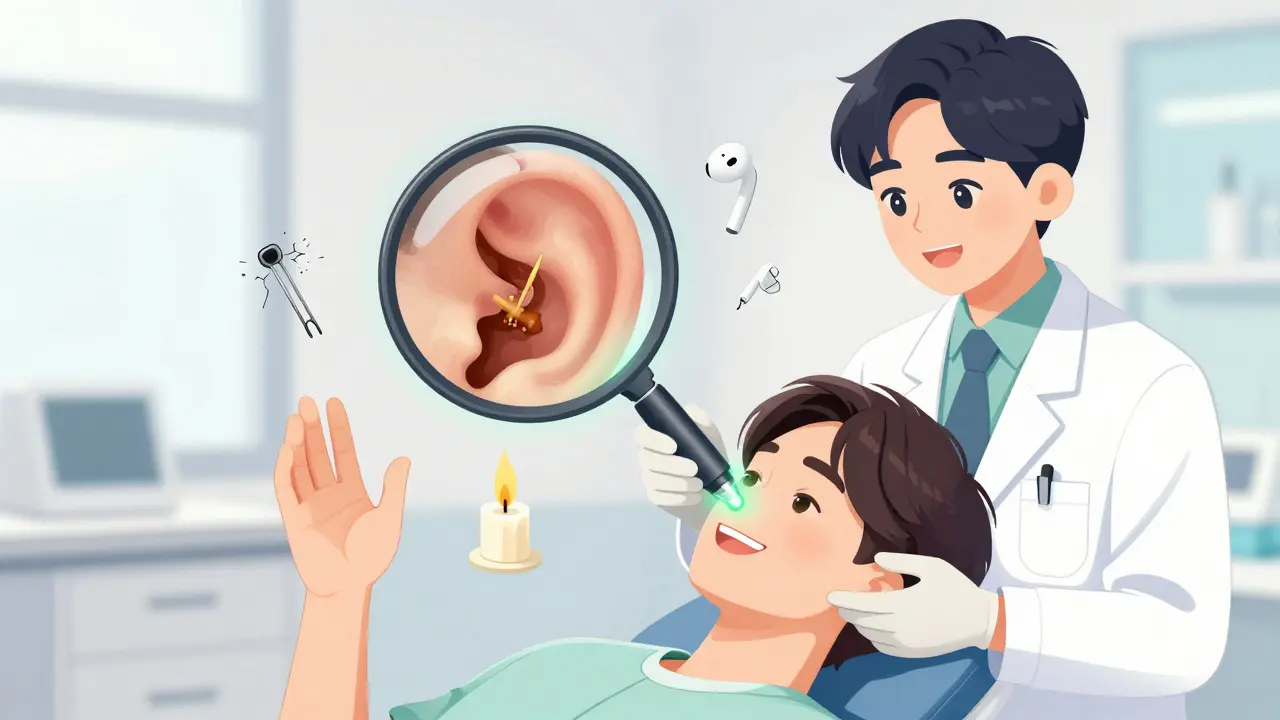
Let’s clear this up once and for all: ear candling doesn’t work. It’s not just ineffective-it’s risky. The FDA has recorded over 12,500 ear injuries between 2018 and 2022 from people using candles, suction devices, or sharp objects. About 3,000 of those were perforated eardrums. That’s not a scare tactic. That’s data.“Never insert anything smaller than your elbow,” is a common warning on Reddit’s audiology forums. And it’s true. You can’t see what you’re doing down there. A single slip can puncture the eardrum, damage the tiny bones behind it, or push wax even deeper. One man in Perth told his ENT he used a bobby pin to “dig out” wax. He ended up with a perforated eardrum and six months of hearing loss.
Hydrogen peroxide? It’s in many over-the-counter kits, but it can irritate the skin inside your ear. About 15% of users report burning or itching after use. And if you have a hidden perforation? It can cause serious pain or infection.
And those TikTok videos showing people pulling out giant clumps of wax with scoops? They’re not showing you the 100 other people who went to the ER after doing the same thing. Over 1.2 billion views on unsafe ear cleaning techniques as of late 2023. That’s not education. That’s a public health risk.
Safe, Proven Ways to Remove Impacted Wax
If you have symptoms, there are three safe, evidence-backed ways to fix it-and only one should be your first step.Step 1: Soften the wax at home
For mild cases, try a cerumenolytic agent. These are solutions that soften wax so your body can clear it naturally. The most effective? Carbamide peroxide (like Debrox or Murine). Studies show it works in 65% of cases after four days. Mineral oil, baby oil, or glycerin work almost as well (58%) and are cheaper. Put 2-3 drops in the ear, lie on your side for 5-10 minutes, then let it drain out. Repeat 3-4 times a day for 3-5 days. Then gently wipe the outer ear with a damp cloth. Don’t stick anything inside.
The NHS recommends olive oil as a safe, natural option. Just make sure you’re not allergic to nuts if you’re using almond oil. This isn’t a cure-all, but it often does the trick.
Step 2: Professional removal
If home softening doesn’t work, or if you have pain, dizziness, or a history of ear problems, see a professional. There are three main methods doctors use:
- Microsuction-This is the gold standard. A tiny vacuum gently sucks out the wax under direct vision. It’s 96% effective, quick (under 20 minutes), and safe even if you’ve had ear surgery. No water involved. No risk of infection. Most patients say they hear better immediately.
- Manual removal-An ENT uses a small curette or forceps to carefully remove the wax. It’s 92% effective in one visit. Requires skill. Not for beginners.
- Ear irrigation-Warm water or saline is gently flushed into the ear. It’s 85% effective, but not safe for everyone. If you’ve ever had a perforated eardrum, ear tubes, or a history of ear infections, this method is off-limits. One wrong pressure spike can cause damage.
Most people get relief in a single visit. Ohio State University found that 85% of patients are completely clear after one professional session. Microsuction has the highest satisfaction rate-92% on Trustpilot. Irrigation is good, but less reliable for hard, dry wax.
When to See a Doctor
Don’t wait until it hurts. See a doctor if:- Your hearing has dropped suddenly
- You have dizziness, ringing, or ear pain
- You’ve tried home softeners for 5 days with no improvement
- You have a history of ear surgery, perforation, or chronic infections
- You notice drainage, odor, or bleeding from the ear
And here’s something most people don’t know: doctors don’t diagnose impaction just by seeing wax. They need to see wax and symptoms. That’s why so many people get told “you’re fine” even if their ear looks full. If you’re not having symptoms, leave it alone.

What Happens If You Ignore It?
Left untreated, impacted earwax can cause more than just hearing loss. It can lead to:- Chronic ear infections (otitis externa)
- Temporary hearing loss that lasts for weeks
- Worsening tinnitus
- Balance problems and falls in older adults
- Masking of other ear conditions like cholesteatoma or tumors
That’s why the American Academy of Family Physicians says: treat impaction only when it causes symptoms. But if it’s causing symptoms? Don’t delay. The longer you wait, the harder the wax gets-and the harder it is to remove.
The Bigger Picture: Why This Keeps Happening
The global earwax removal market is worth nearly $400 million and growing. But most of that money is spent on products that don’t work-or worse, harm you. The FDA has labeled ear candles as “misbranded devices” since 2010. Yet they’re still sold everywhere.Meanwhile, the real solution is simple: education. Doctors, nurses, and audiologists are seeing more cases because people believe the myth that ears need cleaning. Dr. William Luxford from the House Clinic says, “90% of impaction cases result from well-intentioned but misguided cleaning attempts.”
And it’s not just about tools. It’s about access. In Australia, only 45% of cases are handled by ENT specialists. Most go to GPs or urgent care centers. But not all GPs are trained in microsuction. That’s why some patients get irrigation when they shouldn’t, or are sent home with drops that don’t help.
There’s hope on the horizon. In 2023, the FDA cleared the first prescription-only home ultrasonic device, the Eareto OtoSonic. Early trials show 78% effectiveness. And new telehealth tools are being tested to help doctors assess earwax via smartphone video-accuracy is around 89%.
But for now, the best advice is still the oldest: don’t stick anything in your ear. Let your body do its job. And if something feels off? See a professional. Not a YouTube tutorial.
Can earwax cause permanent hearing loss?
No, earwax impaction doesn’t cause permanent hearing loss. The hearing loss it causes is temporary and fully reversible once the wax is removed. But if left untreated for a long time, it can mask other serious conditions like tumors or nerve damage, which might be missed if you assume it’s just wax. That’s why it’s important to get checked if your hearing doesn’t return after removal.
Is it safe to use hydrogen peroxide for earwax?
It can be, but it’s not ideal. Hydrogen peroxide solutions are about 52% effective at softening wax, but they irritate the ear canal in 15% of users, causing burning or itching. If you have a history of ear infections, perforations, or ear surgery, avoid it entirely. Safer alternatives like mineral oil or carbamide peroxide are just as effective and gentler.
Why does my ear feel clogged even after I cleaned it?
Because you probably pushed the wax deeper. Cotton swabs, bobby pins, and even your finger can compact the wax against your eardrum. That’s why you still feel blocked-even after cleaning. The solution isn’t more cleaning. It’s softening the wax with oil and letting it drain naturally, or seeing a professional to remove it safely.
Can earwax impaction cause dizziness?
Yes. The inner ear controls balance, and when wax presses against the eardrum, it can interfere with the signals sent to your brain. About 18% of people with impaction report dizziness. Once the wax is removed, the dizziness usually goes away within hours or days. If it doesn’t, you may have another underlying issue, like an inner ear infection.
How often should I get my ears checked for wax buildup?
You don’t need routine checks unless you’re at high risk. That means you use hearing aids, have a history of impaction, have narrow ear canals, or are over 65. For most people, if you’re not having symptoms, you don’t need to do anything. If you do have symptoms, see a doctor-don’t wait for a scheduled checkup.
What to Do Next
If you’re experiencing symptoms: stop using cotton swabs. Start using a few drops of olive oil or mineral oil twice a day for five days. If there’s no improvement, book an appointment with your GP or an ENT. Ask if they offer microsuction-it’s the safest, most effective option. Don’t buy earwax kits from pharmacies unless they’re carbamide peroxide-based. And never, ever use candles, suction devices, or sharp objects.Your ears are designed to take care of themselves. Your job isn’t to clean them. It’s to leave them alone-unless they’re telling you something’s wrong. Then, get help. Not from a video. From a professional.
Rob Webber
January 30, 2026 AT 13:39Stop feeding the myth. People stick Q-tips in their ears like it’s a goddamn hobby and then wonder why they sound like they’re underwater. You don’t clean your lungs with a toothbrush, so why the hell are you jamming cotton into your ear canal? The ear isn’t broken. You are.
calanha nevin
January 31, 2026 AT 09:22Earwax is not dirt. It’s a natural, protective secretion designed by evolution to keep your ear healthy. Most people never need to intervene. The real problem isn’t wax buildup-it’s the cultural obsession with ‘cleaning’ what isn’t dirty. If you’re not experiencing symptoms, leave it alone. Your ears know what they’re doing.
Claire Wiltshire
February 1, 2026 AT 20:04Thank you for this clear, science-backed breakdown. Many people don’t realize that earwax impaction is often self-inflicted. The fact that 60-70% of cases stem from cotton swab use is alarming-and preventable. I’ve shared this with my elderly patients who’ve been told by well-meaning family members to ‘clean out’ their ears. Now they know better.
Darren Gormley
February 2, 2026 AT 09:58Sidhanth SY
February 2, 2026 AT 12:12I used to use Q-tips every day. Then I started wearing earbuds for work and noticed my hearing felt dull. I tried olive oil drops for five days-no drama, no mess-and my hearing came back. No doctor visit needed. Sometimes the simplest fix is the right one. Don’t overthink it.
Beth Cooper
February 4, 2026 AT 05:10Wait-so you’re telling me the FDA knows ear candles are dangerous but they’re still sold everywhere? And no one’s shutting down the companies? That’s not negligence. That’s a cover-up. Big Pharma doesn’t want you fixing your own ears with oil. They make billions off microsuction appointments and ‘earwax removal kits’ that don’t work. Think about it.
Donna Fleetwood
February 4, 2026 AT 12:03You guys are doing amazing work spreading awareness. Seriously. I used to be the person with the Q-tip in my pocket at all times. Now I just let my ears be. And honestly? I feel better. Not just physically-mentally too. Like I stopped fighting my body. Small changes, big impact.
Bobbi Van Riet
February 4, 2026 AT 22:37I’m 58 and started noticing muffled hearing last year. I thought it was aging, but then I read this and tried the mineral oil trick. Three days in, I felt like someone turned the volume up. I didn’t even go to the doctor. But I do want to say-this isn’t just about wax. It’s about how we’ve been lied to for decades. We’ve been taught to fear our own bodies. And that’s a bigger problem than earwax ever was.
Carolyn Whitehead
February 6, 2026 AT 07:40Natasha Plebani
February 8, 2026 AT 04:50The biological imperative of cerumen production is an elegant example of homeostatic regulation in a confined, high-stakes anatomical environment. The ear canal’s keratinocyte migration, coupled with sebaceous and apocrine secretory activity, forms a dynamic self-cleaning biomechanical system. When external agents-particularly rigid, cylindrical implements-disrupt the ciliated epithelial transport gradient, they induce stasis, compaction, and neural compression. The cough reflex, mediated by the auricular branch of the vagus nerve, is not a coincidence-it’s a somatosensory feedback loop. We are not designed to intervene. We are designed to observe.
Kelly Weinhold
February 9, 2026 AT 05:17Reading this made me feel so much better. I used to feel guilty for not cleaning my ears every day. Like I was lazy or unhygienic. But now I realize-my body’s been taking care of me all along. I’m not going to buy another earwax kit. I’m going to trust my ears. And if something feels off? I’ll see a professional. Not a YouTube influencer. Thank you for this.