
Dissolution Testing: How FDA Ensures Generic Drug Quality
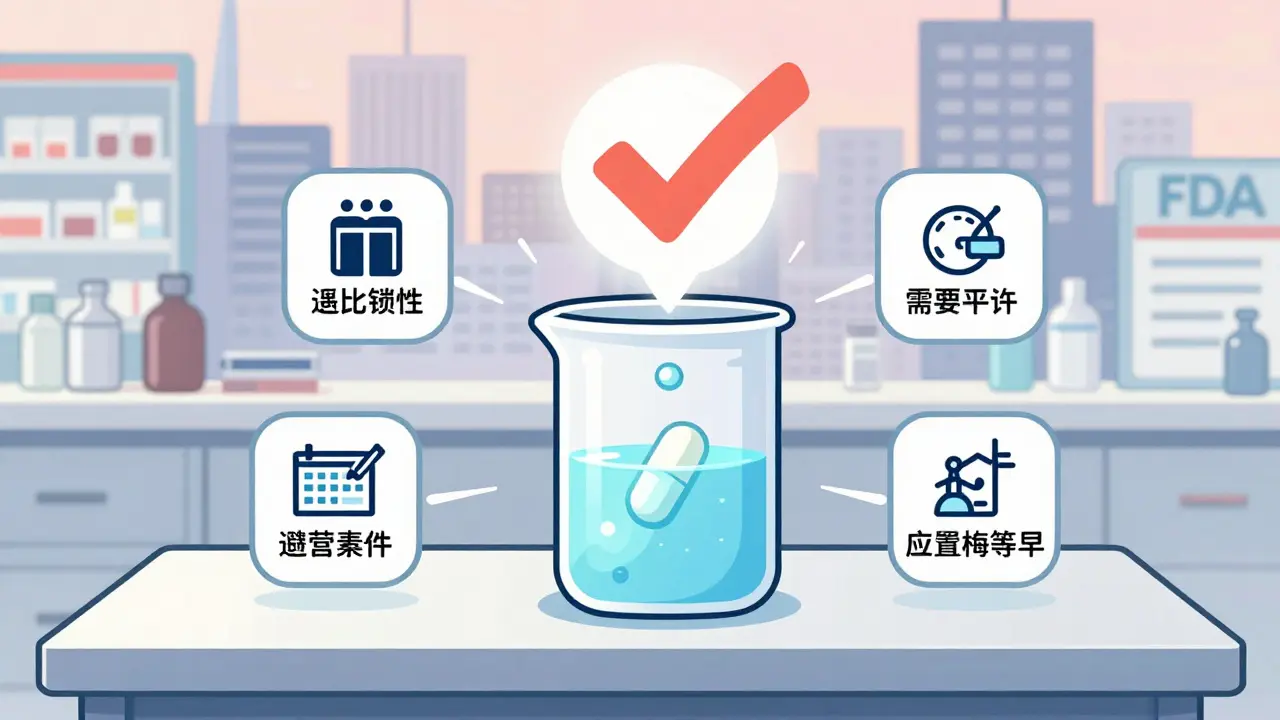
When you pick up a generic pill at the pharmacy, you expect it to work just like the brand-name version. But how does the FDA make sure it does? The answer lies in a quiet but powerful lab test called dissolution testing. This isn’t just a formality-it’s the backbone of how the FDA guarantees that every generic drug you take releases its active ingredient the same way the original does.
Why Dissolution Testing Matters
Dissolution testing measures how quickly a drug releases its active ingredient in a controlled lab environment. Think of it like this: if a pill doesn’t dissolve properly in your stomach, it won’t be absorbed. That means it won’t work. For brand-name drugs, companies run full clinical trials to prove effectiveness. But for generics? The FDA doesn’t require those expensive human studies. Instead, they rely on dissolution testing to predict how the drug will behave in the body.
This test is required for all oral solid pills, capsules, and suspensions. It’s not needed for liquids or topical creams because those are already dissolved or absorbed directly. The goal? To prove the generic version releases its drug at the same rate and in the same amount as the original-no more, no less.
The FDA’s Five Requirements
The FDA doesn’t just ask for one test. It demands five specific types of data before approving any generic drug:
- Solubility of the active ingredient-How well does the drug dissolve in water and stomach fluids?
- Test conditions-What equipment is used (usually USP Apparatus 1 or 2), what’s the rotation speed (often 50-100 rpm), what’s the fluid (like 0.1N HCl or pH 6.8 buffer), and how much fluid is used (typically 500-900 mL)?
- Method robustness-Does the test still work if conditions change slightly? For example, if the temperature rises by 1°C or the rotation speed drops by 5 rpm?
- Analytical accuracy-Can the lab reliably measure how much drug is in the solution? This isn’t as simple as it sounds. Some drugs are hard to detect at low concentrations.
- Discriminatory power-Can the test tell the difference between a good formulation and a bad one? This is especially critical for slow-release pills or drugs with low solubility.
These aren’t suggestions. They’re mandatory. Skip one, and your application gets rejected.
What the Numbers Mean
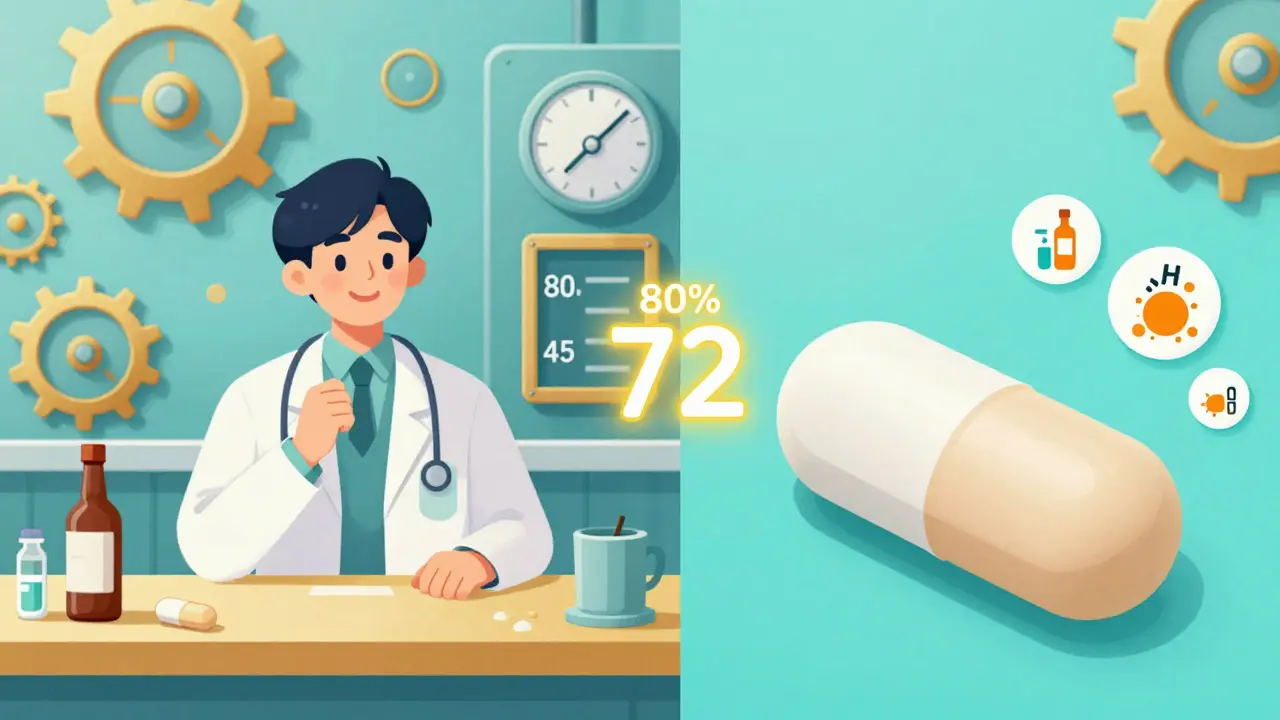
For most immediate-release pills (like aspirin or ibuprofen), the FDA requires at least 80% of the drug to dissolve within 45 minutes. But that’s not a one-size-fits-all rule. The exact number depends on the drug.
Take a high-solubility drug that meets BCS Class I criteria (high solubility, high permeability). For these, the FDA allows a simpler test: one time point-30 minutes-using 900 mL of 0.1N HCl. If the generic matches the brand-name drug at that single point, it’s approved. No human studies needed. This is called a biowaiver, and it’s saved manufacturers millions in development costs.
For more complex drugs-like those that release slowly over hours-the test gets harder. Manufacturers must test under multiple pH levels (1.2 for the stomach, 4.5 and 6.8 for the intestines) and even add alcohol to simulate what happens if someone takes the pill with a drink. This is called alcohol challenge testing. Why? Because if the pill releases all its drug too fast when mixed with alcohol, it could cause dangerous overdoses.
The f2 Similarity Factor
How do you compare two dissolution profiles? You don’t just look at one time point. You look at the whole curve. The FDA uses a mathematical tool called the f2 similarity factor. It scores how similar the dissolution curves of the generic and brand-name drug are, from 0 to 100.
An f2 score of 50 or higher means the two products are statistically equivalent. A score below 50? The FDA will ask for more data-or reject the application. This isn’t a guess. It’s based on years of research linking dissolution curves to actual absorption in the human body.
Category 1, 2, and 3: The FDA’s Three Rules
The FDA doesn’t treat all drugs the same. They group them into three categories based on whether a standardized test already exists:
- Category 1: A USP method already exists (like USP <711>). The generic must match it exactly.
- Category 2: No USP method, but the brand-name drug has a published method. The generic must match that profile.
- Category 3: No published method at all. The manufacturer must develop and prove a new one from scratch.
Most generics fall into Category 1 or 2. But for Category 3 drugs-often new or complex formulations-manufacturers spend 6 to 12 months just designing a valid test. And even then, the FDA might ask for more.
Real-World Challenges
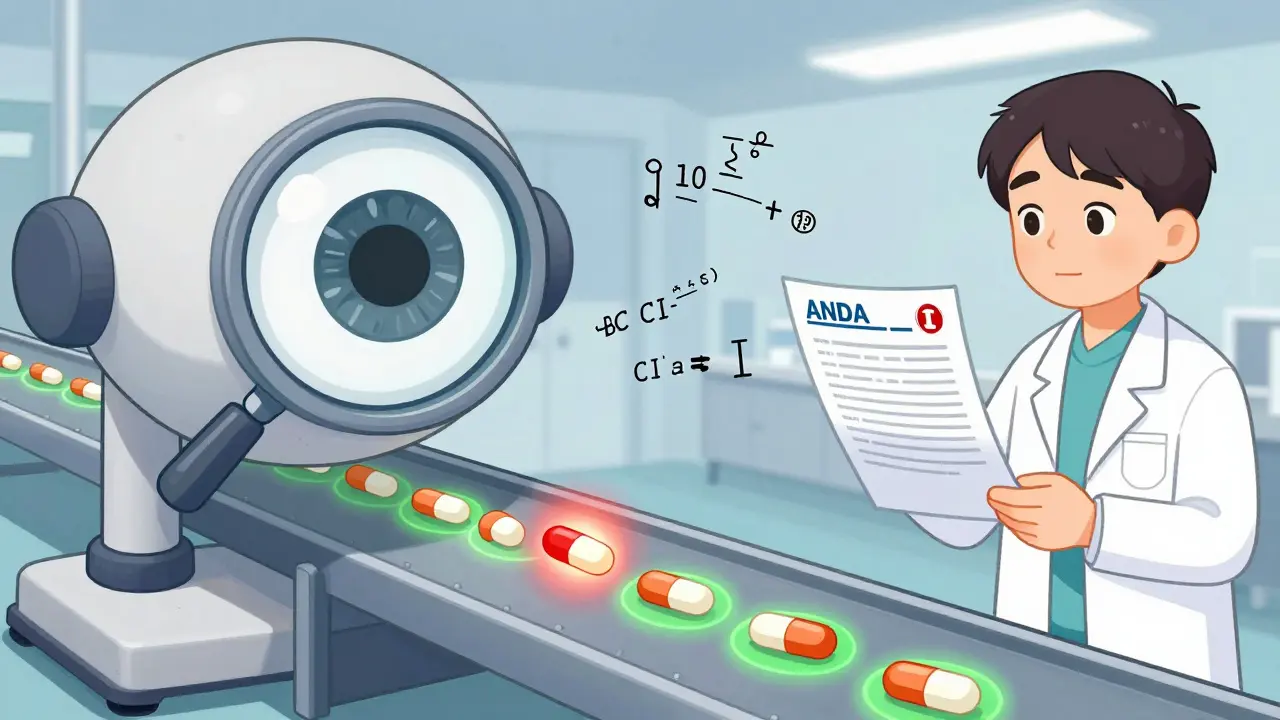
Manufacturers don’t just submit data. They submit hundreds of pages of method development reports. Each ANDA (Abbreviated New Drug Application) includes a 50-100 page section detailing every experiment, every change, every failed trial. Why? Because the FDA needs to see that the method isn’t arbitrary-it’s scientifically sound.
There’s also the FDA’s Dissolution Methods Database, which lists recommended methods for over 2,800 drug products. It’s a lifeline for manufacturers trying to avoid reinventing the wheel. But even with this database, some drugs are stubborn. Low-solubility drugs like itraconazole or fenofibrate can behave unpredictably. Their dissolution curves change based on tiny variations in excipients or particle size. That’s why the FDA insists on methods with strong discriminatory power.
What Happens After Approval?
Approval isn’t the end. The FDA also uses dissolution testing to monitor changes after a drug hits the market. If a company switches suppliers, changes the manufacturing site, or tweaks the formula, they must prove the new version still dissolves the same way. This is called SUPAC-IR (Scale-Up and Post-Approval Changes for Immediate Release). One change, one test. No exceptions.
And if a drug is later found to have a different dissolution profile than expected-even if patients aren’t reporting problems-the FDA can pull it from the market. Dissolution data is the first red flag.
The Bigger Picture
Dissolution testing is how the FDA balances two goals: getting safe, effective generics to market quickly, and never compromising on quality. It’s a system built on science, not trust. By using lab tests to predict what happens in the body, the FDA avoids unnecessary human trials-while still ensuring every pill you swallow does exactly what it’s supposed to.
By 2025, an estimated 35% of generic approvals will rely on these standardized dissolution methods-up from 25% in 2020. That’s progress. But the FDA’s message is clear: dissolution must be product-specific. No shortcuts. No assumptions. Just data.
What is dissolution testing in generic drugs?
Dissolution testing is a lab procedure that measures how quickly a generic drug releases its active ingredient under controlled conditions. It’s used by the FDA to prove that the generic behaves the same way as the brand-name drug in the body, without needing human trials.
How does the FDA decide if a generic drug is bioequivalent?
The FDA uses dissolution testing as a surrogate for bioequivalence. If the generic matches the brand-name drug’s dissolution profile-especially with an f2 similarity score of 50 or higher-it’s considered bioequivalent. For some simple drugs, this eliminates the need for human studies entirely.
What is the f2 similarity factor?
The f2 similarity factor is a statistical tool the FDA uses to compare the dissolution curves of two drug products. An f2 score of 50 or above means the two profiles are similar enough to be considered equivalent. A score below 50 triggers further review or rejection.
Why is dissolution testing required for some drugs but not others?
Dissolution testing is required for oral solids like pills and capsules because their absorption depends on how well they dissolve. It’s not needed for liquids, injections, or topical creams because those are already dissolved or absorbed directly through the skin.
Can a generic drug be approved even if its dissolution profile is different from the brand?
Yes-but only if the difference is scientifically justified. If the generic performs differently in the lab but still shows bioequivalence in human studies, the FDA may approve it with unique dissolution specifications. This is rare and requires strong evidence.
What role does the BCS play in dissolution testing?
The Biopharmaceutics Classification System (BCS) groups drugs by solubility and permeability. For BCS Class I drugs (high solubility, high permeability), the FDA allows simplified testing-often just one time point-because these drugs are reliably absorbed. This enables biowaivers and faster approvals.
Amit Jain
February 3, 2026 AT 12:19Dissolution testing is the unsung hero of generic drugs. No fancy clinical trials, just solid science to make sure your $5 pill works like the $50 one. Simple, reliable, and saves millions. The FDA got this right.
Kunal Kaushik
February 4, 2026 AT 09:20Honestly? I never thought about how a pill dissolves. Now I’m kinda obsessed. 🤯 This is the kind of behind-the-scenes stuff that actually keeps people safe. Good job, FDA.
Mandy Vodak-Marotta
February 5, 2026 AT 09:14Okay but let’s be real-this whole system is wild. They don’t test on humans for generics, they just stick it in a beaker with acid and spin it like a salad spinner? And somehow, that’s enough to say ‘this works the same’? I mean, I trust it, but also… wow. The amount of chemistry and math packed into a single pill is insane. I just took ibuprofen this morning and didn’t think twice. Now I’m staring at the capsule like it’s a spaceship.
Keith Harris
February 6, 2026 AT 19:11Don’t be fooled. This whole ‘f2 similarity factor’ is a corporate loophole dressed up as science. The FDA lets generics slide with a 50 score? That’s barely better than coin-flip territory. I’ve seen data where two drugs have identical dissolution curves but wildly different bioavailability because of excipient interactions. They ignore that because it’s cheaper. This isn’t safety-it’s cost-cutting with a lab coat.
Zachary French
February 7, 2026 AT 01:12Let me break this down for you all, because clearly y’all haven’t read the actual USP guidelines. Dissolution testing isn’t just ‘spin it in acid’-it’s a multivariate nightmare of hydrodynamics, surface tension, and polymer kinetics. The apparatus isn’t just ‘a beaker with a paddle’-it’s a precision-engineered vessel calibrated to within 0.1 rpm. And the f2 factor? It’s not a ‘score’-it’s a multivariate statistical model derived from 20+ years of pharmacokinetic modeling. You think a generic company just guesses the pH? Nah. They run 37 different buffer conditions, test at 3 temperatures, and validate with HPLC-MS/MS. And if you think Category 3 is ‘hard’-try developing a method for a poorly soluble drug with polymorphic variability and no reference standard. I’ve done it. It took 14 months. The FDA didn’t blink. They demanded 12 more runs. This isn’t bureaucracy. It’s pharmacology on steroids.
Daz Leonheart
February 7, 2026 AT 06:51It’s easy to take this for granted, but this system is why millions of people can afford their meds. No drama, no hype-just good science that works. Keep doing the quiet, hard work, FDA. We see you.
Harriot Rockey
February 7, 2026 AT 18:05Love that this is so detailed and science-backed. 🙌 I’m a nurse, and I’ve seen patients panic when their generic looks different. This kind of transparency helps us explain why it’s still safe. Also, the BCS Class I biowaiver? Genius. It means faster access for people who need it most. Thank you for making this so clear.
Nathan King
February 9, 2026 AT 14:52While the regulatory framework is commendable, one must acknowledge the inherent limitations of dissolution testing as a surrogate for bioequivalence. The assumption that in vitro dissolution profiles perfectly correlate with in vivo absorption is predicated on a narrow set of physicochemical parameters. For drugs exhibiting pH-dependent solubility or those subject to first-pass metabolism, the model becomes increasingly tenuous. The FDA’s reliance on statistical similarity, while pragmatic, risks normalizing empirical approximations as biological equivalency. A more rigorous, mechanism-based approach-perhaps integrating PBPK modeling-would elevate the standard from acceptable to exemplary.
Demetria Morris
February 10, 2026 AT 08:07So let me get this straight-big pharma gets to skip human trials, save millions, and still sell you a pill that’s supposed to be ‘the same’? And we’re supposed to trust a machine in a lab that spins water? This isn’t science. It’s corporate convenience wrapped in jargon. People die because generics don’t work right. And the FDA just shrugs and says ‘f2 > 50.’ That’s not regulation. That’s negligence dressed up in a white coat.