
Calcium, Iron, and Mineral Interactions with Medications: What You Need to Know
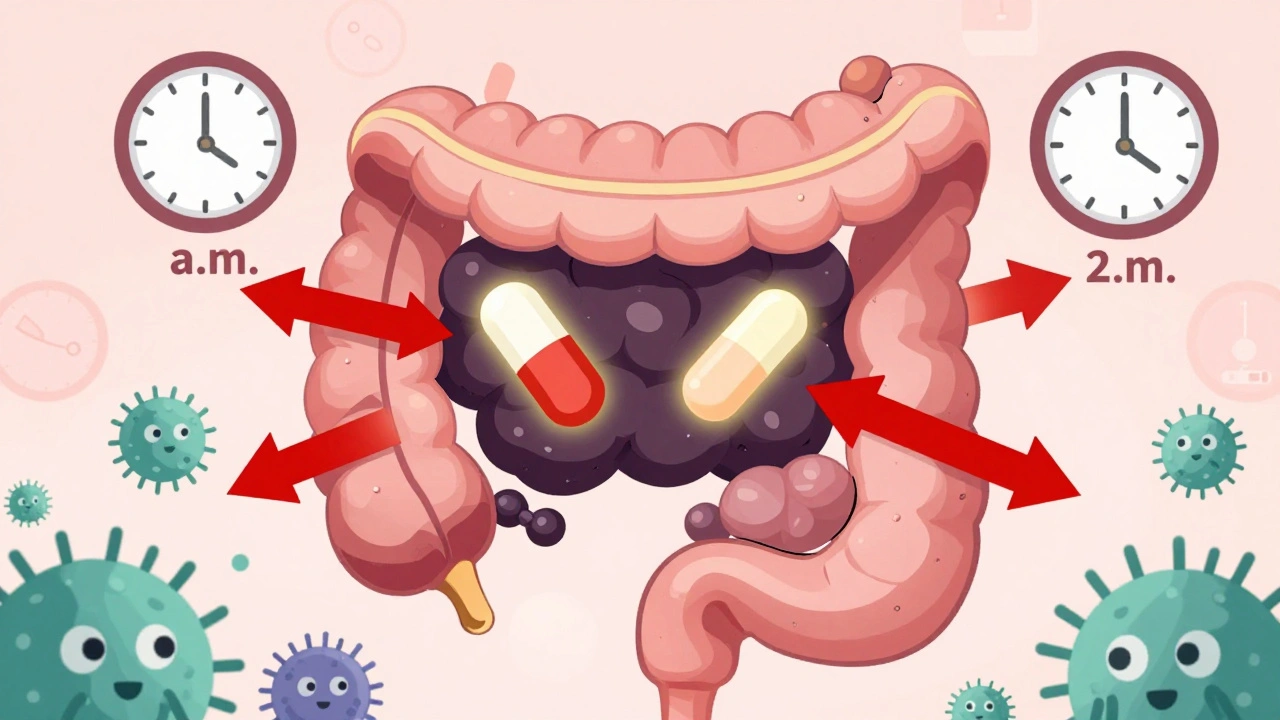
Many people take calcium or iron supplements without realizing they could be making their prescription drugs less effective. It’s not just about forgetting a pill-it’s about when and how you take them. A calcium supplement taken with your antibiotic might stop that drug from working. An iron pill taken with your heartburn medicine could leave you still anemic. These aren’t rare edge cases. They happen every day, often without anyone noticing-until something goes wrong.
How Calcium Blocks Antibiotics
Calcium doesn’t just build bones. It also binds to certain antibiotics like tetracycline, doxycycline, minocycline, and fluoroquinolones such as ciprofloxacin and levofloxacin. When calcium meets these drugs in your gut, they form a hard, insoluble complex that your body can’t absorb. The result? The antibiotic never reaches the infection.Studies show calcium carbonate can cut the absorption of ciprofloxacin by 40%. That’s not a small drop-it’s enough to turn a successful treatment into a failed one. If you’re on antibiotics for a sinus infection or urinary tract infection, and you’re also taking a calcium pill for osteoporosis, you might think you’re doing everything right. But if you took them together, you could be leaving bacteria alive and giving them time to grow stronger.
Doctors and pharmacists recommend waiting at least two hours between calcium and these antibiotics. But for safety, many experts suggest four to six hours. That means if you take your antibiotic at 8 a.m., don’t take your calcium until after 2 p.m. If you take calcium at night, avoid antibiotics after dinner.
Iron and Antibiotics: A Similar Problem
Iron supplements like ferrous fumarate, ferrous sulfate, and ferrous gluconate do the same thing. They bind tightly to tetracycline and fluoroquinolone antibiotics, creating the same kind of blockage. The result? The antibiotic doesn’t work. The infection doesn’t clear. You might even need a second course-or worse, end up in the hospital.The timing rule for iron and antibiotics is slightly more flexible than calcium’s, but still strict. Take the antibiotic at least two hours before your iron pill, or wait four hours after. That means if you take your iron at breakfast, hold off on your antibiotic until after lunch. If you take your antibiotic at night, take your iron in the morning.
And here’s the catch: iron isn’t just blocked by calcium. It’s also blocked by anything that reduces stomach acid. That includes proton pump inhibitors (PPIs) like omeprazole and pantoprazole, and H2 blockers like famotidine. These heartburn meds are commonly prescribed for long-term use. But if you take them with your iron, your body won’t absorb it properly. Iron needs acid to dissolve and move into your bloodstream. No acid? No iron absorption.
Calcium and Thyroid Medicine: A Silent Threat
One of the most dangerous interactions isn’t with antibiotics-it’s with levothyroxine, the most common thyroid medication. People on this drug often have low energy, weight gain, and depression. If their thyroid levels aren’t right, they feel worse. But calcium supplements-whether from a pill or fortified orange juice-can cut levothyroxine absorption by up to 50%.Research from the South Medical Journal shows that even if you take calcium just two hours after levothyroxine, your thyroid hormone levels drop. The fix? Wait at least four hours between doses. Most people take levothyroxine first thing in the morning on an empty stomach. That’s good. But if they take their calcium pill right after breakfast, they’re undoing the benefit.
The solution? Take levothyroxine at least 30 to 60 minutes before breakfast. Then wait until lunch or later to take calcium. If you take your thyroid med at night, wait until the next morning to take calcium. Consistency matters. Skip one day, and your levels swing. Do it regularly, and your doctor might keep raising your dose-thinking you’re not taking it-when you actually are, just not at the right time.

Iron and Milk: A Common Mistake
Parents often give iron supplements to children with anemia. And many are told to take it with orange juice to help absorption. But some still give it with milk, thinking it’s better for the stomach. That’s a mistake. Milk contains calcium-and calcium binds to iron, just like it does with antibiotics.HealthyChildren.org points out that iron taken with milk can be up to 50% less absorbed. That means a child might be on iron therapy for months and still show no improvement. The fix is simple: use orange juice, apple juice, or even a vitamin C tablet with the iron. Vitamin C helps iron dissolve and move into the blood. Milk? Save it for later.
Timing Is Everything
Here’s a simple guide to spacing your minerals and meds:- Calcium and antibiotics (tetracyclines, fluoroquinolones): Wait 4-6 hours apart.
- Calcium and levothyroxine: Wait at least 4 hours.
- Iron and antibiotics: Take antibiotic 2 hours before or 4 hours after iron.
- Iron and heartburn meds (PPIs, H2 blockers): Take iron 2 hours before the heartburn pill.
- Iron and milk: Avoid. Use vitamin C-rich drinks instead.
It’s not about being perfect. It’s about being consistent. If you take your iron with breakfast every day, and your antibiotic at lunch, you’re probably fine. But if you sometimes skip the gap because you’re in a rush, you’re risking your treatment.

What About Other Minerals?
Magnesium, zinc, and aluminum (found in some antacids) also interfere with antibiotics and thyroid meds. Magnesium in supplements or laxatives can reduce absorption of ciprofloxacin and levothyroxine. Zinc can interfere with tetracyclines. Aluminum in antacids like Maalox or Mylanta can bind to both iron and antibiotics.The pattern is the same: minerals bind to drugs. The fix: time them apart. If you’re on any supplement and any prescription, ask your pharmacist: “Do these interact?” Don’t assume they don’t. Many people don’t even tell their doctor they’re taking calcium or iron supplements.
What Should You Do?
- Make a list of every supplement and medication you take-daily or occasionally.
- Bring it to your pharmacist or doctor. Ask: “Are any of these conflicting?”
- Write down the spacing rules for your specific meds. Put them on your fridge or phone.
- Use a pill organizer with time slots. Separate your minerals and meds into different compartments.
- Don’t rely on memory. Even one missed gap can reduce drug effectiveness.
It’s easy to think supplements are harmless. But calcium and iron aren’t just vitamins-they’re powerful chemicals that change how your body handles medicine. You wouldn’t mix bleach and ammonia. Don’t mix your pills and supplements without knowing the rules.
When to Call Your Doctor
If you’ve been taking calcium or iron with your meds and you notice:- Your infection isn’t getting better
- You’re still tired despite taking iron
- Your thyroid symptoms (weight gain, cold sensitivity, brain fog) aren’t improving
It might not be your dose. It might be your timing. Tell your doctor about your supplement use. They might adjust your schedule, switch your antibiotic, or test your blood levels to see if absorption is the issue.
Can I take calcium and iron together?
No. Calcium and iron compete for absorption in the gut. Taking them together reduces how much of each your body can use. If you need both, space them at least 2-4 hours apart. Iron is usually more critical for immediate health, so take it first, then calcium later in the day.
Does it matter if I take my mineral supplement with food?
For iron, yes. Iron absorbs best on an empty stomach, but it can cause stomach upset. If that happens, take it with a small amount of food-preferably something with vitamin C, like a piece of orange or bell pepper. Avoid high-fiber foods, dairy, tea, or coffee, as they block absorption. Calcium can be taken with food to reduce stomach upset, but avoid it with antibiotics or thyroid meds regardless of food.
What if I forget and take them together by accident?
One mistake won’t ruin your treatment, but don’t make it a habit. If you accidentally take calcium with your antibiotic, skip that dose and wait until the next scheduled time. Don’t double up. For iron and thyroid meds, just resume your regular schedule. If it happens often, change your routine-move one of the supplements to a different time of day.
Are there supplements that don’t interact?
Yes. Vitamins like B12, D, and C generally don’t interfere with medications. Magnesium and zinc can, so check those too. Always ask your pharmacist about any new supplement-even if it’s labeled “natural” or “herbal.” Some herbal products, like St. John’s Wort, also interfere with many drugs.
Why don’t doctors always warn me about this?
Many doctors assume patients will read the pill inserts or ask questions. But most people don’t. Pharmacists are better trained to catch these interactions, but they can’t read your mind. If you’re taking supplements, tell your doctor and pharmacist every time you visit. Don’t wait for them to ask. It’s your health-and your responsibility to speak up.
Managing mineral and medication interactions isn’t complicated. It’s just a matter of knowing the rules and sticking to them. A few extra minutes of planning can mean the difference between feeling better and feeling worse. Don’t let a simple timing mistake undo months of treatment. Check your schedule. Talk to your pharmacist. Take control.
Inna Borovik
December 6, 2025 AT 13:44Let’s be real-this isn’t about timing. It’s about pharmaceutical capitalism. The system wants you dependent on meds, so they bury the truth: minerals aren’t the problem, it’s that your body’s being starved of bioavailable nutrients by processed food and chronic stress. You take calcium because your bones are crumbling from vitamin D deficiency, not because you’re ‘doing it right.’ The real fix? Eat real food. Stop swallowing pills like candy.
And don’t get me started on how PPIs are prescribed like candy. Acid reflux isn’t ‘too much acid’-it’s too little. Your stomach’s screaming for HCl, not suppression. But hey, Big Pharma sells more when you’re on lifelong PPIs, right?
So yes, spacing matters. But the real tragedy? We’ve outsourced our physiology to pill schedules because we’ve lost touch with how to nourish ourselves. You’re not broken. The food system is.
And before you say ‘I don’t have time to cook,’ ask yourself: who made you believe your health is a logistical puzzle instead of a biological imperative?
Arjun Deva
December 8, 2025 AT 12:07Wait… so you’re telling me… the government… and Big Pharma… are working together… to keep us sick… by hiding the fact that… calcium… iron… and minerals… are the real cure… but they’re too dangerous… to let us use… without a prescription…??
And now they want us to… wait… 4… 6… HOURS… between pills… so we stay… confused… and… dependent…?
I knew it… the ‘timing’… is just a distraction… so we don’t notice… that… the entire medical system… is a… pyramid scheme… built on… pill counting…
Who benefits… if we’re all… constantly… checking clocks… instead of… eating… real food…?
WHO BENEFITS…?
WHO BENEFITS…?
WHO BENEFITS…??
Katie O'Connell
December 9, 2025 AT 07:51While the temporal separation of mineral supplements and pharmaceutical agents is indeed a well-documented pharmacokinetic concern, one must also consider the bioavailability matrix of chelated versus non-chelated forms. The literature, particularly in the Journal of Clinical Pharmacology, indicates that calcium citrate exhibits markedly reduced interference with fluoroquinolones compared to calcium carbonate, owing to its superior solubility profile.
Moreover, the notion of a universal ‘four-hour window’ is an oversimplification. Circadian variation in gastric pH, intestinal motility, and CYP450 enzyme activity modulate absorption kinetics-factors rarely accounted for in clinical guidelines. One might reasonably posit that a personalized, chronobiologically-informed regimen would yield superior outcomes.
Additionally, the concomitant administration of vitamin C with iron, while empirically supported, ignores the role of hepcidin regulation in systemic iron homeostasis. The assumption that ‘more absorption’ is always beneficial is, frankly, reductionist. Iron overload, particularly in the context of genetic hemochromatosis, remains tragically underdiagnosed.
One must, therefore, approach this not as a matter of scheduling, but as a complex, individualized biochemical negotiation. To reduce it to bullet points is to misunderstand the very nature of human physiology.
pallavi khushwani
December 10, 2025 AT 20:39my mom took her thyroid med and calcium together for 3 years and didn’t know why she was always tired. she finally asked her pharmacist and they were like ‘ohhhhh that’s why.’ now she takes her calcium at dinner and feels like a new person. i’m just glad someone finally wrote this down so i can send it to my whole family.
also-orange juice with iron? yes. milk? no. why is this even a question?
so simple. so ignored. so important.
Geraldine Trainer-Cooper
December 12, 2025 AT 09:28we treat our bodies like machines you can program with pills
but we’re not robots
we’re messy, broken, beautiful animals who evolved to eat berries and roots and meat
and now we’re trying to fix what’s broken with more chemicals and more timing rules
what if the problem isn’t the calcium
what if the problem is that we don’t eat real food
and we’ve forgotten how to listen to our bodies
just saying
Karen Mitchell
December 13, 2025 AT 17:11It is utterly irresponsible to present such a complex pharmacological interaction as a simple ‘timing’ issue without emphasizing the legal and ethical obligations of healthcare providers to disclose these interactions. The fact that patients are left to navigate this labyrinth on their own is not negligence-it is malpractice. If a physician prescribes levothyroxine and a patient is also taking calcium supplements, it is not the patient’s duty to ‘remember’ to space them. It is the physician’s duty to document, flag, and counsel accordingly.
And yet, in 90% of cases, this does not happen. Why? Because the system is designed to maximize throughput, not outcomes. You are not lazy. You are being failed.
Furthermore, the suggestion to ‘ask your pharmacist’ is a cop-out. Pharmacists are overworked, underpaid, and often lack access to full patient histories. This is not a consumer responsibility. It is a systemic failure.
And before you say ‘just take the pill at night’-not everyone can. Some work night shifts. Some have gastroparesis. Some are elderly and on 17 medications. Your ‘simple guide’ is tone-deaf.
Dan Cole
December 15, 2025 AT 06:32Let’s cut through the noise. This isn’t about ‘timing.’ It’s about control. The medical-industrial complex doesn’t want you to understand how your body works. They want you to believe that every problem requires a pill-and that pill must be taken at the exact right time, with the exact right ritual, or else you’re doomed. That’s not medicine. That’s cult behavior.
Calcium doesn’t ‘block’ antibiotics. It chelates them. That’s chemistry. Not magic. You don’t need to wait four hours-you need to understand ion binding. But if you understood chemistry, you wouldn’t be taking supplements in the first place-you’d be eating leafy greens and red meat.
And why are we still using ferrous sulfate? It’s the worst form of iron-highly irritating, poorly absorbed, and causes constipation. Use ferrous bisglycinate. It doesn’t interact as badly. But no one tells you that because it’s not profitable.
Stop treating your body like a puzzle. Start treating it like an ecosystem.
Kay Jolie
December 16, 2025 AT 06:22OMG I JUST REALIZED I’VE BEEN TAKING MY CALCIUM WITH MY ANTIBIOTIC FOR 6 MONTHS.
THAT’S WHY MY SINUS INFECTION NEVER WENT AWAY.
AND I THOUGHT I WAS JUST ‘TOO STRESSED’.
MY PHARMACIST SAID I WAS ‘OVERDOING IT’ WITH SUPPLEMENTS.
NO. I WAS JUST DOING IT WRONG.
THANK YOU FOR WRITING THIS.
MY BODY ISN’T BROKEN.
I WAS JUST BEING A DUMBASS.
EDIT: I JUST MOVED MY CALCIUM TO DINNER. I FEEL LIKE A NEW PERSON.
PS: I’M TAKING VITAMIN C WITH MY IRON NOW. I’M NOT GOING BACK.
Clare Fox
December 17, 2025 AT 17:24i think we forget that our bodies were never meant to be timed like alarm clocks
we used to eat when we were hungry, sleep when we were tired, and didn’t have to worry about whether our iron clashed with our heartburn med
now we’re all just… managing interactions
like our bodies are a software update that keeps crashing
and we’re the tech support
it’s exhausting
maybe the answer isn’t more rules
maybe it’s less pills
just a thought
Mansi Bansal
December 18, 2025 AT 11:25AND THIS IS WHY AMERICA IS FALLING APART.
People take calcium because they’re too lazy to drink milk.
They take iron because they eat nothing but pasta and soda.
They take PPIs because they eat greasy pizza at 2 a.m. and then wonder why they’re bloated.
And now they want a 6-hour gap between pills like it’s a NASA launch sequence?
NO.
THE PROBLEM ISN’T THE TIMING.
THE PROBLEM IS THAT WE’VE GONE FROM FOOD TO PILLS IN ONE GENERATION.
YOU DON’T NEED A SCHEDULE.
YOU NEED A DIET.
STOP TAKING SUPPLEMENTS.
EAT A STEAK.
EAT SPINACH.
EAT AN ORANGE.
AND THEN YOU WON’T NEED TO WORRY ABOUT ANY OF THIS.
THIS ISN’T MEDICINE.
THIS IS A CULTURE OF AVOIDANCE.
AND I’M TIRED OF IT.
Akash Takyar
December 19, 2025 AT 13:35Thank you for sharing this clear, evidence-based guide. Many people suffer needlessly because they are unaware of these interactions. I have seen patients with persistent anemia despite iron therapy-only to discover they were taking it with omeprazole. Once the timing was adjusted, their ferritin levels improved dramatically within weeks.
For those feeling overwhelmed: start small. Pick one interaction to fix first-perhaps calcium and your antibiotic. Once that becomes routine, move to the next. You don’t need to change everything overnight.
And please, speak up to your pharmacist. They are your allies. Most are eager to help-you just have to ask.
Small changes, done consistently, create big results. You’ve got this.
Jackie Petersen
December 20, 2025 AT 10:59So let me get this straight-some foreign country’s government is secretly making us take calcium supplements so our antibiotics don’t work and we get sicker so they can sell us MORE drugs??
AND NOW THEY WANT US TO WAIT 4 HOURS??
WHY NOT 7 HOURS??
WHY NOT 12??
WHY NOT JUST STOP GIVING US PILLS ALTOGETHER??
THIS IS A COVER-UP.
THEY’RE MAKING US SICK ON PURPOSE.
AND THEY’RE USING ‘SCIENCE’ TO MAKE IT SOUND LEGIT.
WHY DIDN’T THE MEDIA TELL US??
WHY DIDN’T THE GOVERNMENT WARN US??
WHO’S PAYING THE PHARMACISTS??
WHY ISN’T THIS ON CNN??
Nava Jothy
December 21, 2025 AT 05:01My heart breaks for everyone who’s been silently suffering because no one told them about this...
I remember my grandma crying because she took her thyroid med with her calcium smoothie-and she thought she was doing everything right. She lost 10 pounds, couldn’t sleep, felt like a ghost...
When the pharmacist finally told her to wait 4 hours? She said, ‘I thought I was being good.’
It’s not your fault.
It’s not your fault you didn’t know.
It’s not your fault you trusted the system.
But now you know.
And now you can be free.
❤️
Take your iron with orange juice.
Take your thyroid on an empty stomach.
Wait.
Breathe.
You’re going to be okay.
Dan Cole
December 21, 2025 AT 06:39Just read the comment above about grandma. That’s why I wrote this. One person changes their routine, and it ripples. That’s the real science-not the chemistry, not the timing. It’s the human moment when someone says, ‘I didn’t know.’ And then they learn.
And then they tell someone else.
That’s how this stuff spreads.
Not through journals.
Through stories.