
Amblyopia: How Patching Therapy Helps Children Develop Normal Vision
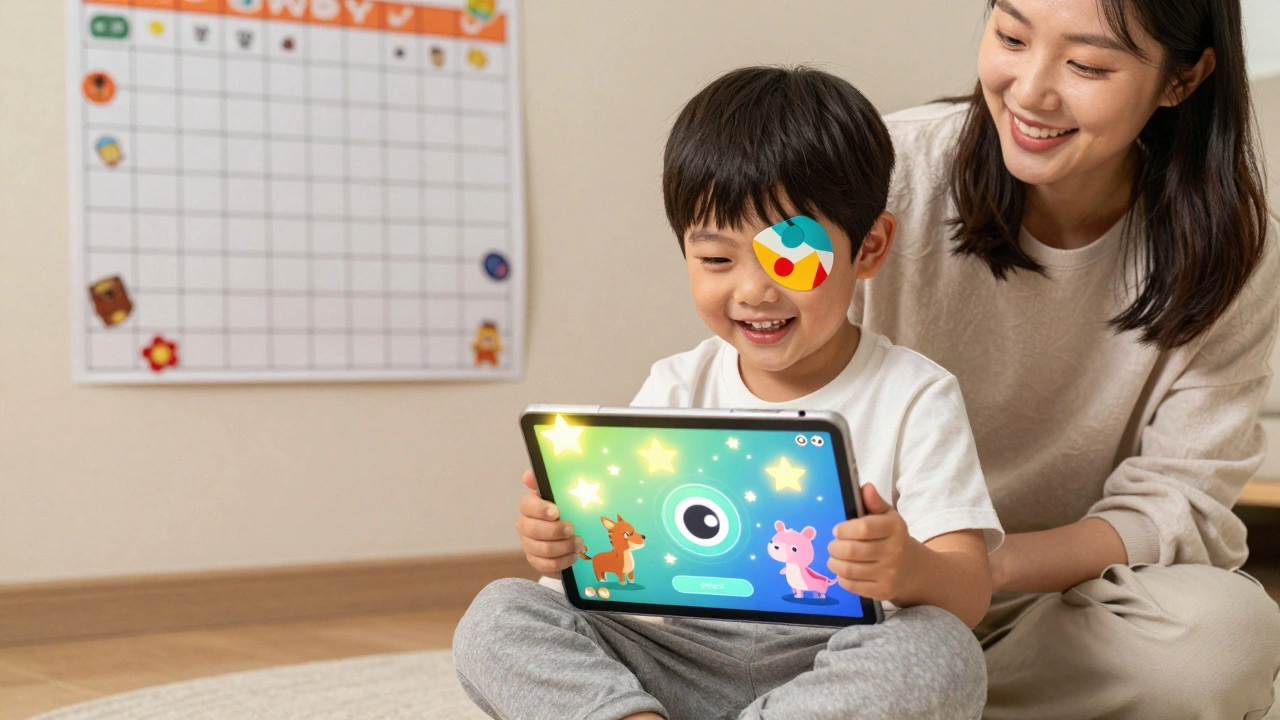
One in every 50 children has a hidden vision problem that no glasses can fix. It’s not blurry vision from nearsightedness. It’s not a cataract or a misshapen eye. It’s amblyopia - often called "lazy eye" - where the brain ignores signals from one eye because it never learned to see properly during early childhood. Left untreated, this isn’t just a temporary issue. It can lead to permanent vision loss in that eye, even if the eye itself is physically healthy.
What Exactly Is Amblyopia?
Amblyopia happens when the brain and eye don’t work together right from the start. During the first few years of life, the brain is learning how to interpret what the eyes see. If one eye sends a blurry, double, or blocked image - because of misalignment, a big difference in prescription, or something blocking light - the brain starts to ignore that eye. Over time, the connection between that eye and the brain weakens. The eye doesn’t go blind. But it stops seeing clearly, no matter how strong the glasses are. This isn’t something you can spot just by looking. A child with amblyopia won’t complain about seeing poorly. They don’t know any different. That’s why routine eye checks are so important. The American Academy of Pediatrics recommends that all kids get a full eye exam by age 3. Catching it before age 5 gives the best chance for full recovery.Three Main Types of Amblyopia
Not all lazy eyes are the same. There are three main types, each with a different cause:- Strabismic amblyopia - This is the most common, making up about half of cases. It happens when one eye turns inward, outward, up, or down. The brain gets confused seeing two different images, so it just shuts off the turned eye to avoid double vision.
- Anisometropic amblyopia - This affects about 30% of cases. One eye has a much stronger prescription than the other. Maybe one eye is very nearsighted or farsighted, while the other is close to normal. The brain prefers the clearer image and ignores the blurry one.
- Deprivation amblyopia - This is the rarest but most serious. Something physically blocks light from entering the eye - like a congenital cataract, a droopy eyelid (ptosis), or a cloudy cornea. Even if corrected later, the eye may never develop normal vision if treatment is delayed.
Bilateral amblyopia can also happen - when both eyes have strong, uncorrected prescriptions. Kids with this type often don’t seem to have a problem until they’re tested with one eye covered.
Who’s at Risk?
Some kids are more likely to develop amblyopia:- Those born prematurely or with low birth weight (under 2,500 grams)
- Children with a family history - if a parent or sibling had it, the risk goes up by 30-40%
- Kids with developmental delays or neurological conditions
It’s not about screen time or reading too close. It’s about how the brain wires itself during the first few years. The window for normal vision development closes around age 7-8. After that, it’s much harder to fix.
Patching Therapy: The Gold Standard Treatment
The most proven way to treat amblyopia is patching therapy. The idea is simple: cover the stronger eye so the brain has no choice but to use the weaker one. This forces the brain to relearn how to see clearly through that eye. For decades, doctors told kids to wear a patch for 6 hours a day. But research changed that. The landmark Amblyopia Treatment Study (ATS) found that for moderate cases - where vision is between 20/40 and 20/100 - just 2 hours of daily patching works just as well as 6 hours. That’s a big relief for families. Less time patching means less stress, fewer tears, and better chances of sticking with it.What About Atropine Drops?
For kids who won’t wear a patch, or for parents who find it too hard, there’s another option: atropine drops. These are placed in the stronger eye once a day to blur its near vision. The child then uses the weaker eye for reading, drawing, or playing. Studies show this works just as well as patching for moderate amblyopia. About 79% of kids using atropine reach 20/30 vision or better after six months. The big advantage? No patch. No skin irritation. No teasing at school. The downside? It can cause light sensitivity and trouble focusing up close. It’s not ideal for kids who need perfect distance vision for sports or driving lessons later on.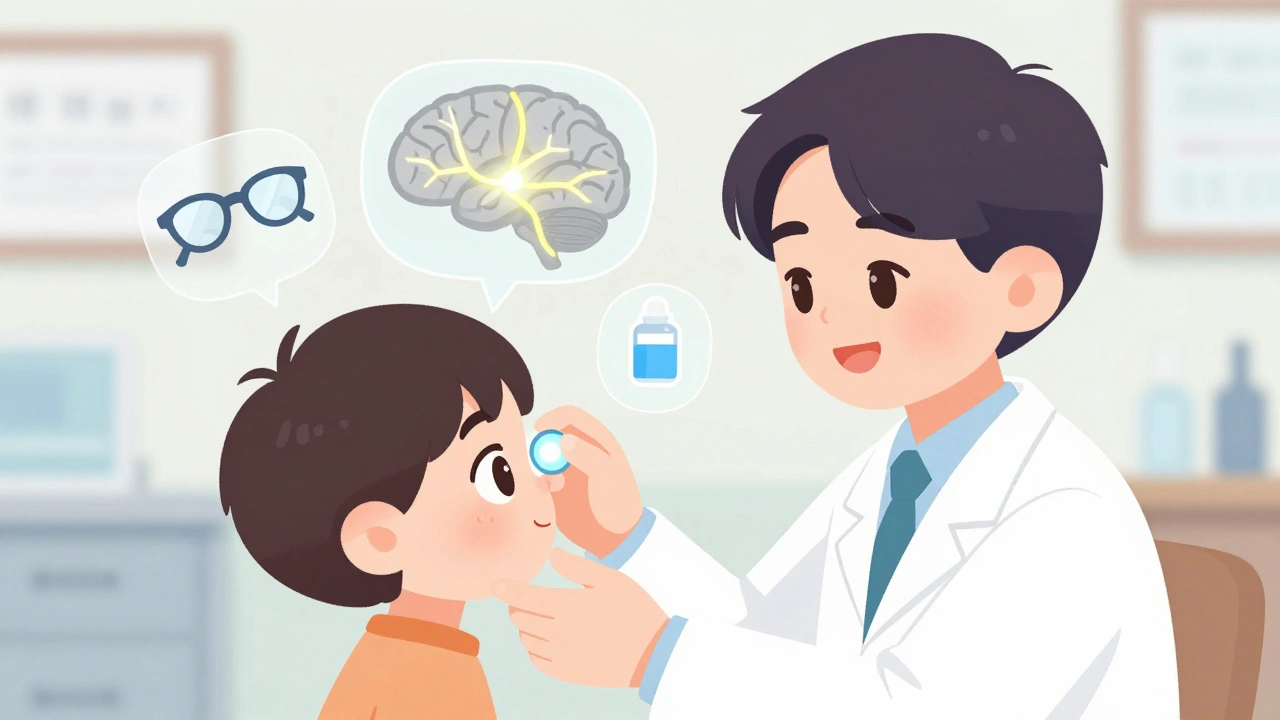
Other Treatments: Filters, Games, and More
Some kids reject patches and drops. For them, there’s the Bangerter filter - a thin, frosted sticker applied to the lens of glasses over the strong eye. It blurs vision just enough to encourage use of the weaker eye. Research shows it works about 60-70% of the time, especially in older kids who find patches embarrassing. Then there’s digital therapy. Platforms like AmblyoPlay - cleared by the FDA in 2021 - use video games and interactive tasks designed to stimulate the weaker eye. Kids play for 15-30 minutes a day, doing exercises that train focusing, tracking, and depth perception. Real-world data from European clinics shows 75% compliance with these apps - far higher than traditional patching. In some cases, combining digital therapy with patching leads to 15-20% better improvement in 3D vision (stereopsis).Why Compliance Is the Biggest Hurdle
No treatment works if it’s not used. Studies show only 40-60% of kids stick with patching as prescribed. Parents quit because:- The child cries, resists, or removes the patch
- Skin gets red, itchy, or irritated
- Other kids tease them at school
- Parents don’t understand why it’s so important
Successful families use tricks:
- Start slow - 30 minutes a day, then build up
- Make it fun - "patching parties" with siblings or friends
- Use reward charts - stickers for each day, small prizes after a week
- Try digital trackers like "LazyEye Tracker" - used by over 20% of pediatric eye clinics
One of the biggest factors? Parent education. When parents understand that this isn’t just about seeing better - it’s about rewiring the brain - adherence jumps from 45% to 89%. The brain’s ability to change (neuroplasticity) is strongest before age 5. After that, it still works, but slower.
How Long Does Treatment Take?
This isn’t a quick fix. Most kids need treatment for 6 to 12 months. Some need it longer. Follow-up visits every 4-8 weeks are crucial. The doctor checks vision with each eye covered and adjusts patching time or tries a new approach if progress stalls.What About Surgery?
If the amblyopia is caused by a turned eye (strabismus), surgery to straighten it may be needed first. But surgery alone doesn’t fix the lazy eye. After alignment, patching or drops are still required to train the brain to use both eyes together. About 70-80% of kids who have strabismus surgery still need ongoing amblyopia treatment.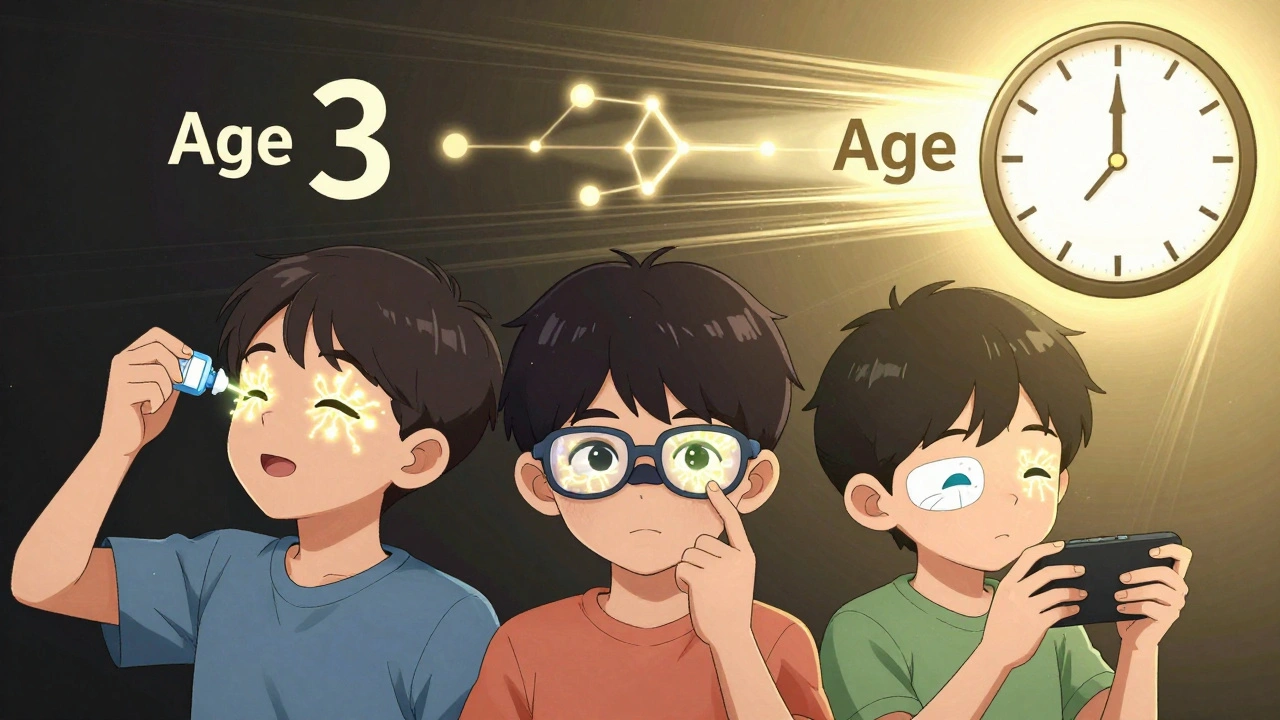
Can Adults Be Treated?
For years, doctors said it was too late after age 8. But new research is changing that. While adults won’t regain the same level of vision as children, some can improve with intensive perceptual learning - tasks that challenge the brain to process blurry or conflicting images. Studies show modest gains in clarity and depth perception. It’s not a cure, but it’s better than nothing.What’s the Real Success Rate?
The good news? Almost all kids - 97% - will show some improvement with proper treatment. But full recovery? That’s harder. Only 65-75% reach normal or near-normal vision (20/20 or close). The rest may still have slight blurriness or reduced depth perception. That’s why early treatment matters so much.Children treated before age 5 recover 85-90% of their vision. Between ages 5 and 7, that drops to 50-60%. After age 8, gains become small and slow. That’s why screening at age 3 isn’t just a recommendation - it’s the best chance for a child to see the world clearly for life.
What Comes Next?
New tools are on the horizon. Transcranial random noise stimulation (tRNS) - a mild electrical current applied to the scalp - is being tested in clinical trials. Early results show it can boost patching results by 40%. Weekend-only atropine dosing is being studied to make treatment easier. And digital platforms are getting smarter, adapting games in real-time based on how the child responds.But the core hasn’t changed. Vision develops in early childhood. If one eye is ignored, the brain forgets how to use it. Patching, drops, filters, or digital therapy - they all work by forcing the brain to pay attention. The earlier you start, the better the outcome.
Can amblyopia fix itself without treatment?
No. Amblyopia won’t go away on its own. The brain continues to ignore the weaker eye, and the connection weakens further over time. Without treatment, vision in that eye will remain permanently reduced, even with glasses or contact lenses.
How do I know if my child has amblyopia?
Most children show no obvious signs. They don’t complain, and they often cover one eye without realizing it. The only reliable way to detect it is through a comprehensive eye exam by a pediatric ophthalmologist or optometrist. Routine screening at age 3 is critical - don’t wait for symptoms.
Is patching painful or dangerous?
Patching isn’t painful, but it can be uncomfortable. Some kids get skin irritation from adhesive patches. Using hypoallergenic patches, rotating placement, or switching to atropine drops can help. There’s no risk to the eye itself - the patch only blocks light, not vision. The goal is to strengthen the weaker eye, not harm the stronger one.
Can my child wear contact lenses instead of glasses for patching?
Yes - but only if they have a refractive error that needs correction. Contact lenses don’t replace patching. They correct the blurry image, but the brain still needs to be forced to use the weaker eye. Patching or atropine is still required. Contact lenses alone won’t treat amblyopia.
How often should my child have follow-up visits?
Every 4 to 8 weeks during active treatment. This lets the doctor measure progress, adjust patching time, and catch any setbacks early. Once vision stabilizes, visits may drop to every 3-6 months. Stopping follow-ups too soon is one of the top reasons treatment fails.
Will my child need glasses forever?
Not necessarily. If the amblyopia was caused by a refractive error, glasses may be needed only during treatment. Once vision stabilizes, some children can reduce or stop wearing them - but only under a doctor’s supervision. Others, especially those with high prescriptions, may need glasses long-term for clear vision.
Are digital therapies as effective as patching?
For moderate amblyopia, digital therapies like AmblyoPlay show similar results to patching - and much better compliance. They’re especially helpful for older kids who resist patches. But they work best when combined with regular eye exams and professional oversight. They’re a tool, not a replacement for medical care.
James Kerr
December 1, 2025 AT 23:46My nephew got patched for 3 months last year - total game changer. He used to bump into everything, now he’s catching baseballs like a pro. 🎯😎
shalini vaishnav
December 3, 2025 AT 04:45How can you trust Western medicine when they still don’t understand the root cause? In India, we’ve treated this with Ayurvedic eye exercises for centuries - no patches, no drugs. Just patience, turmeric, and discipline. You people rely too much on gadgets.
vinoth kumar
December 4, 2025 AT 04:53Just wanted to say - this is the most clear explanation of amblyopia I’ve ever read. My daughter was diagnosed last year and I was lost. Now I get why patching isn’t just ‘covering an eye’ - it’s retraining the brain. Huge thanks for writing this.
bobby chandra
December 6, 2025 AT 00:47Let’s be real - this isn’t just medicine, it’s a revolution in neuroplasticity. We’re not patching eyes, we’re hacking the brain’s wiring diagram. And digital therapies? That’s the future. Imagine a kid playing Fortnite while their visual cortex rebuilds itself. Mind. Blown. 🤯
Archie singh
December 7, 2025 AT 20:12Of course it works. The brain adapts. But why do we wait until age 3? Because the system is broken. Pediatricians are overworked, parents are clueless, and insurance won’t cover it unless the kid’s vision is already destroyed. This is capitalism failing children.
Gene Linetsky
December 7, 2025 AT 22:40Ever wonder why the FDA cleared those digital games? Because Big Pharma doesn’t make money off apps. Patching is cheap. Drops are cheap. But a subscription-based app that tracks progress? That’s a billion-dollar market. Don’t be fooled - this is profit disguised as progress.
Kidar Saleh
December 8, 2025 AT 15:01As a dad in London, I can’t tell you how many times I’ve had to explain to teachers why my son wears a patch. One said he looked like a pirate. I told her he was a neuroscientist in training. She didn’t get it. But his vision? 20/20 now. Worth every tear.
Chloe Madison
December 9, 2025 AT 12:58As a pediatric optometrist with over 15 years in clinical practice, I can confirm with absolute certainty that early intervention - before age 3 - yields near-perfect outcomes. The data is unequivocal. Parents who delay treatment out of fear or misunderstanding often regret it for life. This is not a choice. It is a medical imperative.
Vincent Soldja
December 10, 2025 AT 23:00Interesting. But where are the long-term follow-up studies beyond age 18?
Rashmin Patel
December 12, 2025 AT 19:22My cousin’s daughter in Jaipur was treated with a combination of atropine and daily coloring activities - she didn’t even know she was being treated! She just loved drawing rainbows. Now she’s 10, plays violin, and sees in 3D. The key isn’t just the treatment - it’s making it feel like play. And yes, I’ve tried every app out there. AmblyoPlay is legit, but the real magic happens when parents join in. Don’t just hand them a tablet - sit with them. Laugh with them. That’s the real therapy.
Cindy Lopez
December 13, 2025 AT 20:30So patching works. Cool. But why do we still call it ‘lazy eye’? That’s stigmatizing. It’s not lazy. It’s underdeveloped. Language matters.
Ignacio Pacheco
December 14, 2025 AT 07:43Wait - so if I cover my left eye while scrolling TikTok for 2 hours a day, will I get better at seeing memes?
Rashi Taliyan
December 15, 2025 AT 11:41I’m so grateful for this post. My sister struggled with amblyopia as a child and was told she’d never drive. She’s a pilot now. I’ve been telling everyone I know to get their kids screened. Don’t wait. Don’t assume. Just go. One visit can change everything.