
Vaccine Generics: Why Global Production and Access Remain Unequal

There is a fundamental misunderstanding about how vaccines work compared to regular pills. When you think of generic drugs, you imagine a cheaper version of a blockbuster medication that works exactly the same way. But for vaccines, that model barely exists. This isn't just a regulatory quirk; it’s a biological reality that shapes who gets protected and who doesn’t. Vaccine generics is a largely non-existent market category because vaccines are complex biologics rather than simple chemical compounds, requiring full new license applications instead of simplified approval pathways. This distinction creates a high barrier to entry that keeps production concentrated in the hands of a few multinational giants, leading to significant access disparities worldwide.
The core issue is simple: you can’t just copy a vaccine like you can copy a tablet. Traditional small-molecule drugs follow a well-established path where once a patent expires, other companies can prove their version is bioequivalent through standard testing. Vaccines don’t have this shortcut. They require intensive capital, specialized facilities, and complex supply chains that take years to set up. As a result, the global landscape remains dominated by a handful of players, leaving low-income countries dependent on imports and vulnerable to supply shocks.
The Biological Barrier: Why Vaccines Aren't Like Other Drugs
To understand the access problem, we first need to look at what makes vaccines different from other medicines. A standard antibiotic or painkiller is a chemical compound with a defined structure. If Company A makes it, Company B can make the exact same molecule. Regulatory bodies like the U.S. Food and Drug Administration (FDA) allow an Abbreviated New Drug Application (ANDA) process for these generics, which speeds up approval and lowers costs.
Vaccines, however, are biologics complex molecules produced using living systems such as cell cultures, which cannot be replicated atom-for-atom across different manufacturing sites. Because they are made using live cells or viral vectors, slight variations in the manufacturing process can change the product's efficacy or safety profile. This means there is no true "generic" vaccine in the traditional sense. Instead, any new manufacturer must file a complete new biological license application, proving the entire process from scratch. The Bill & Melinda Gates Foundation has explicitly noted that there is no "generics" vaccine market comparable to that of drugs due to these intensive capital requirements. This biological complexity is the root cause of the industry's concentration and the resulting price premiums.
Manufacturing Complexity and Supply Chain Fragility
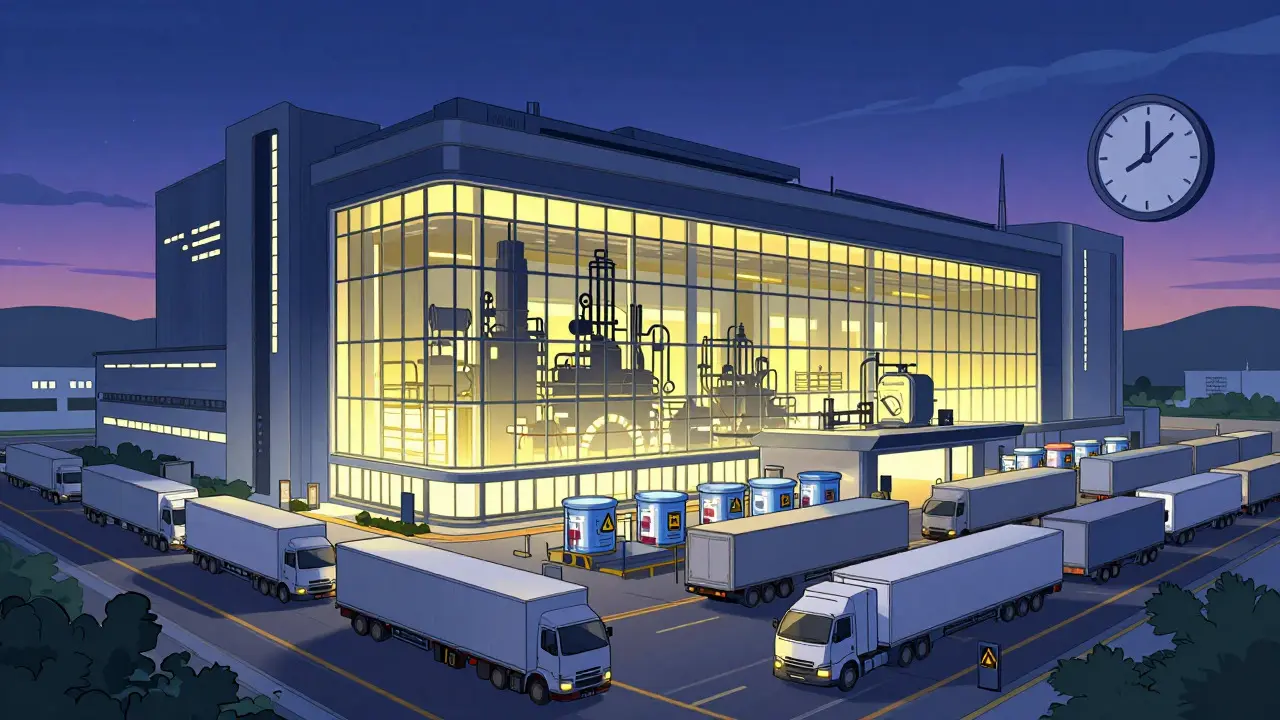
Building a vaccine factory is not like opening a software startup. It requires biosafety level 2 or 3 containment, precise temperature controls, and multi-step processes involving cell culture, purification, and formulation. For mRNA vaccines, for example, the supply chain relies on specialized lipid nanoparticles. Globally, only five to seven suppliers can provide these critical materials. This bottleneck was exposed during the SARS-CoV-2 pandemic when demand skyrocketed.
Consider the scale required. India's Serum Institute, the world's largest vaccine manufacturer by volume, operates 11 facilities with a combined capacity of 1.5 billion doses annually. Even this massive output proved insufficient when global demand exceeded 11 billion doses. Establishing a new facility takes five to seven years and costs between $200 million and $500 million. Technology transfer alone can take 18 to 24 months. In South Africa, the WHO’s mRNA technology transfer hub faced an 18-month delay simply to establish initial production, primarily due to difficulties sourcing specialized equipment. These timelines mean that even if the political will existed to expand production instantly, the physical infrastructure would lag behind by nearly a decade.
| Attribute | Generic Small-Molecule Drugs | Vaccines (Biologics) |
|---|---|---|
| Approval Pathway | Abbreviated New Drug Application (ANDA) | Complete New Biological License Application |
| Bioequivalence Proof | Standard methods, relatively quick | Complex, requires full process validation |
| Capital Requirement | Moderate | Very High ($200M - $500M per facility) |
| Time to Market | 2-4 years post-patent expiry | 5-7 years for new facility setup |
| Price Dynamics | Drops 80-90% with competition | Stable, often 'take-it-or-leave-it' pricing |
The Concentration of Power: Who Controls the Supply?
The economic structure of the vaccine industry is highly concentrated. In 2020, the global vaccine market was valued at $38 billion. Five companies-GSK, Merck, Sanofi, Pfizer, and Johnson & Johnson-controlled approximately 70% of this market. This oligopoly allows manufacturers to maintain higher prices, especially for newer platforms. Unlike generic drugs, where prices plummet once multiple competitors enter the market, vaccine pricing often follows a "take-it-or-leave-it" model.
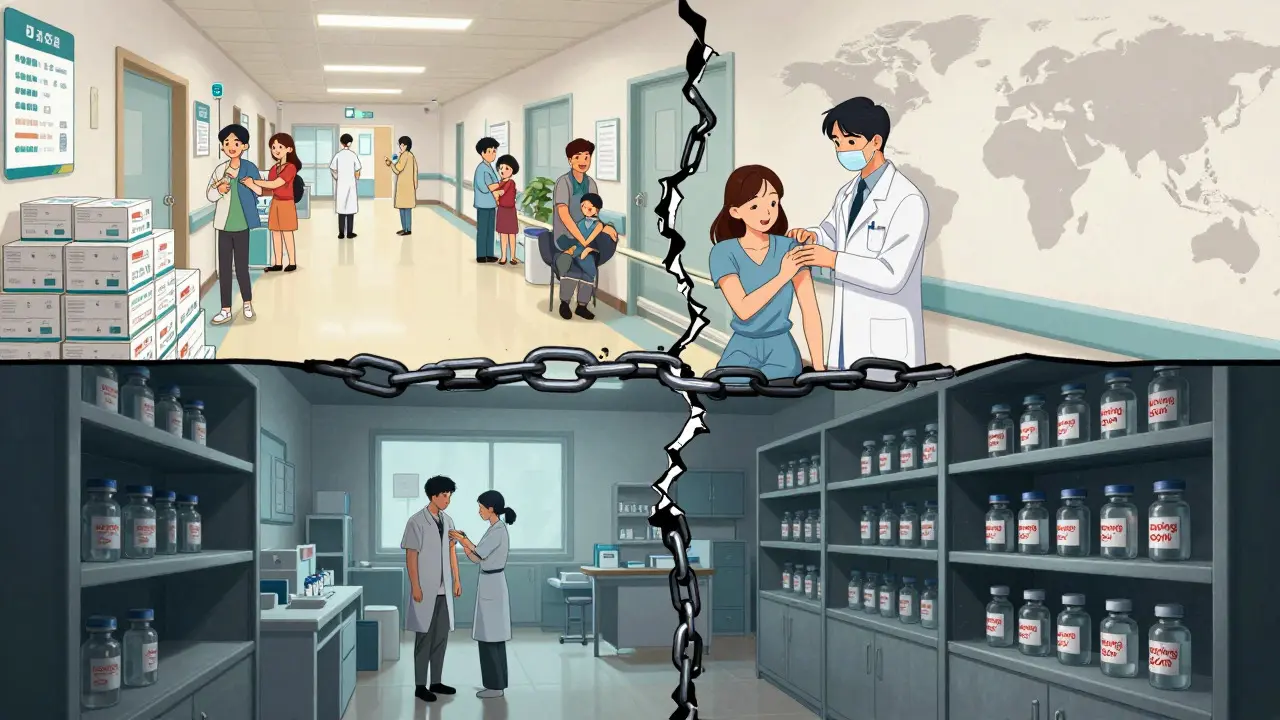
This concentration has direct consequences for global health equity. During the early stages of the COVID-19 pandemic, high-income countries secured 86% of initial doses despite representing only 16% of the global population. While mechanisms like COVAX were designed to bridge this gap, distribution remained uneven. By April 2021, 83% of the 1.1 million doses delivered to Africa through COVAX were administered in just 10 countries, while 23 African nations had vaccinated less than 2% of their populations. The issue isn't just production; it's who gets priority when supply is tight.
The Role of India and the Limits of Export Dependency
India plays a pivotal role in global vaccine access, supplying 60% of the world's vaccine production by volume. The country provides 40-70% of the World Health Organization’s demand for DPT and BCG vaccines, and 90% for measles vaccines. However, relying heavily on one country for essential health products creates vulnerability. When India faced its second wave of infections in 2021, it temporarily halted exports to meet domestic needs. This single decision reduced global vaccine supply by an estimated 50%, highlighting the fragility of a centralized production model.
Furthermore, Indian manufacturers operate on thinner margins than their generic drug counterparts. Producing the AstraZeneca vaccine cost around $3-4 per dose, compared to $15-20 in Western markets, yet the high capital costs of maintaining biosafe facilities kept profits minimal. Additionally, India still imports 70% of its vaccine-related raw materials from China, creating another layer of dependency. If supply chains break at the raw material level, even the largest producers can falter.
Barriers to Expanding Local Production in Low-Income Countries
One proposed solution is to build local manufacturing capacity in low- and middle-income countries, particularly in Africa. The African Union estimates that achieving 60% self-sufficiency would require $4 billion in investment and ten years of development. Currently, Africa imports 99% of its vaccines, despite having a growing pharmaceutical market. The challenge is not just money; it’s technical expertise and infrastructure.
Dr. John Nkengasong, Director of Africa CDC, noted that Africa's generics industry is at an early stage of development, similar to where Asia was in the 1980s. Building this capacity requires more than just factories; it needs reliable cold chain infrastructure, trained personnel, and stable regulatory frameworks. Without these, even if vaccines are produced locally, they may not reach the people who need them. For instance, health workers in the Democratic Republic of Congo have reported receiving doses expiring in two weeks without the necessary cold chain infrastructure to deploy them effectively. Production is only half the battle; distribution is the other.
Future Outlook: Technology Transfer and Policy Shifts
Efforts to democratize vaccine production are gaining momentum but face headwinds. The WHO’s mRNA technology transfer hub in South Africa achieved its first production in September 2023, but at a capacity of only 100 million doses annually-less than 1% of global needs. This suggests that while technology transfer is possible, scaling it up is difficult. Meanwhile, the U.S. FDA launched an ANDA prioritization pilot in 2025 to boost domestic generic drug manufacturing, citing national security risks from overreliance on foreign sources. While this focuses on drugs, the principle applies to vaccines: diversifying production locations reduces systemic risk.
Experts agree that expanding manufacturing is key to equity. Dr. Seth Berkley, CEO of Gavi, projects that low- and middle-income countries will remain 70% dependent on imports by 2025, despite ongoing efforts. The path forward likely involves a mix of increased public investment, stronger technology transfer agreements, and policy reforms that encourage local production. Until then, the gap between those with access and those without will persist, driven by the unique biological and economic realities of vaccine manufacturing.
Are there generic vaccines?
Technically, no. Vaccines are biologics, not small-molecule chemicals, so they don't have true generics in the same way aspirin or antibiotics do. New manufacturers must go through a full licensing process rather than a simplified equivalence pathway.
Why are vaccines so expensive to produce?
Vaccine production requires specialized facilities with strict biosafety standards, complex multi-step manufacturing processes, and specialized raw materials. Setting up a single production line can cost over $500 million, and the process takes 5-7 years to become operational.
Which countries produce the most vaccines?
India is the largest producer by volume, supplying about 60% of the global vaccine supply. Major multinational companies based in the US, UK, France, and Germany also control a significant portion of the market, particularly for newer technologies like mRNA.
How does COVAX help with vaccine access?
COVAX is a global initiative aimed at equitable vaccine distribution. It pools resources to procure vaccines for low-income countries. However, its effectiveness has been limited by global supply shortages and logistical challenges in last-mile delivery within participating countries.
Can local manufacturing solve the access problem?
Local manufacturing can reduce dependency on imports and lower costs in the long run. However, it requires significant upfront investment ($4 billion for Africa alone), technical expertise, and time (10+ years) to achieve meaningful self-sufficiency. It is a long-term solution, not an immediate fix.